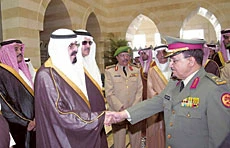
JEDDAH, 10 August 2005 — Custodian of the Two Holy Mosques King Abdullah arrived here yesterday on his first visit to the city after his accession to the throne.
Crown Prince Sultan, Makkah Governor Prince Abdul Majeed and other senior princes and top officials were present at the airport to greet the king.
King Abdullah was accompanied by Prince Miteb, minister of public works and housing, Prince Nawaf, personal adviser to the king, and Interior Minister Prince Naif.
King Abdullah’s decision on Monday to free Abdullah Al-Hamid, Matrouk Al-Faleh, Ali Al-Damini and Saeed ibn Zaeer along with the Libyan assassination plotters reflects not only his strength of character and magnanimity but also the strength of his leadership.
Within a week of becoming the ruler of this country, the spiritual home of more than a billion Muslims, the king demonstrated that the security and stability of the country is intact and in safe hands. Those who would create dissent and mischief should realize there is a strong government capable of handling whatever arises in a manner beneficial to the interests of the country and its people.
The decision to release the Libyan plotters also was an example of the king’s magnanimity and the farsightedness of the Saudi leadership. This act itself was commended by the Arab League, which described it as wise and an important step toward creating true Arab unity.
However, no matter what analysts outside our borders have to say, it is important to understand and comprehend the situation in the light of the area’s new geopolitical dimensions. Many self-styled activists jumped on the bandwagon — especially after 9/11 — hoping that criticism of the country by the Western media would help propel them as reformers.
These self-styled “reformers” in many ways had ulterior motives. Politically immature and having no experience whatsoever, they danced to the tunes of foreign critics. Thrust into the limelight they fell victim to hubris. With neither specific plans nor agendas that could encompass a vast land with many divergent groups, their calls for reforms were naive and unrealistic given the complexities of this great nation.
While some outsiders whose “educated analyses” are both general and simplistic rallied to their causes, true proponents of reform tempered their views of these matters with more realistic appraisals of the importance of building a broad consensus and planning with care and deliberation to move this Kingdom forward.
Egged on by detractors of the Kingdom and frustrated with the difficulties of our daunting challenges, such misguided and narrow attempts at presenting reforms actually could have created chaos and pandemonium, and, worse yet, a backlash against the much-needed changes our nation requires for progress and prosperity in the future.
At a time when instability abounds in the Middle East, we must preserve our national unity. Carelessly crafted calls for reform that create confusion in the minds of many not only are unpatriotic, they may prove to be idiotic if they move us backward.
Yes, we all acknowledge that there are issues that must be dealt with, and dealt with they will be — but with wisdom and concern for all of the nation’s constituent groups and with a long-term view so that the changes we make today are the changes that will ensure a better tomorrow for our children and the generations to follow. The king in his speech spoke positively on these issues; the changes he suggests and the timetable he envisions will be the way to that better tomorrow for all of us to follow.
The people — young and old — have pledged their allegiance to our new king and crown prince. They came from all walks of life and streamed into the governorates across the Kingdom, first condoling and then pledging. When asked to explain this in a modern political context I told a foreign journalist that this is similar to a referendum. The people speak of their own free will. There is no coercion, no herding of people in buses to a polling place, no high-pressure selling. The whole exercise takes place in a dignified manner.
Western analysts too often try to fit the ways of other peoples into a Western model, and they fail to comprehend that the people of Saudi Arabia are fully aware of what’s happening in the country. A transition and orderly succession has occurred. Our new king is a pragmatist and a true proponent of progress. He carries on the rich tradition of his last five predecessors who all were reformers and sought to move this land forward and give its people education, wealth and health their grandparents never could have imagined. These were men of vision, and our new king is no exception.
Overcoming a multitude of hurdles, they were able to drive the point home that social and economic reforms within the parameters of Islam (another thing the Western analysts have a hard time understanding) hold the key to progress. To transform a large tract of land inhabited by warring tribes where brigands prowled into a nation state is no small feat. It takes resolve and determination, strength and a sense of mission.
Our kings have had what it takes to create that transformation, and King Abdullah will continue to transform our land and our lives for the better. Tolerance, grace and magnanimity have been the hallmarks of the previous kings of Arabia. They have not been the leaders of some of the people; they have been the leaders of all of the people, and they have sought to benefit all of the people.
We are confident that Custodian of the Two Holy Mosques King Abdullah and Crown Prince Sultan will continue to uphold these traditions.