
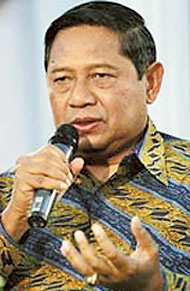
Indonesian President Susilo Bambang Yudhoyono has predicted a 6.2 percent economic growth and pledged to honor a historic agreement with separatist rebels from tsunami-hit Aceh province, while speaking on the occasion of Indonesian national day. The Indonesian government and the Free Aceh Movement (GAM) signed a peace accord on Monday after six months of negotiations, paving the way for an end to three decades of bloodshed that has claimed about 15,000 lives.
Speaking on the occasion of Indonesia’s independence day, President Yudhoyono said that Indonesia’s economic growth would accelerate to 6.2 percent next year, up from a projected 6.0 percent this year. The president, however, warned that the economy will remain susceptible to “drastic changes” in the global environment. Susilo told the House of Representatives in his annual budget speech that high global crude oil prices and the weaker rupiah, Indonesia’s currency, have strained the government’s efforts to maintain economic stability.
To support the rupiah, which has fallen 5 percent against the dollar this year, the government has spent $5 billion since the beginning of the year in foreign exchange markets buying the currency. Government officials and analysts attribute the rupiah’s slide to massive dollar purchases by the state-owned oil and gas company Pertamina to fund oil imports. Crude oil prices currently hover around $65 per barrel.
While a member of OPEC, Indonesia is a net importer of oil, and the government subsidizes oil to keep prices affordable. The central bank hiked its benchmark Bank Indonesia interest rate last week to 8.75 percent from 8.5 percent to support the rupiah and control inflation, which was 7.84 percent in July and 7.42 percent in June.
Yudhoyono said Indonesia’s budget deficit is expected to fall to 0.7 percent of gross domestic product (GDP) in 2006, down from 1.0 percent estimated for this year. Budget financing will include 19.6 trillion rupiah in government investment account and treasury bonds sales and 29.9 trillion rupiah in foreign loans, with the privatization and disposal of banking assets held by PT Perusahaan Pengelola Aset (PPA) also contributing, he said.
Referring to the agreement to rebels, he said: “All items that appear on the memorandum of understanding (MOU) shall be consistently implemented.”
“Therefore, I would like to call on the former GAM activists to also abide by that MOU,” he said. The agreement contains provisions for an amnesty for separatist rebels, the creation of political parties allowing ex-guerrillas to run for office in the province and a withdrawal of non-local security forces by the end of the year.
Yudhoyono also rejected yesterday nationalist criticism that his government was giving foreigners too big a role in an Aceh peace agreement signed this week in Helsinki. The 250-strong Aceh Monitoring Mission (AMM) consists of members from the European Union and five Southeast Asian nations and will be led by senior Dutch conflict expert Pieter Feith.
“The conflict in Aceh is a domestic issue. We never intended to internationalize it,” Yudhoyono said. “The presence of foreign monitors from the European Union and ASEAN to monitor the implementation of the Memorandum of Understanding is not a foreign interference into our domestic affair,” he said. The AMM has wide-ranging tasks in seeing that both parties stick to the truce. For example, the Indonesian military must notify Feith if any commander wants to move troops above a platoon size.