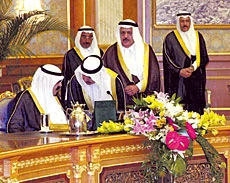
JEDDAH, 23 August 2005 — Custodian of the Two Holy Mosques King Abdullah yesterday ordered a 15 percent salary increase for all Saudi government employees. In addition, more than SR80 billion from this year’s budget was allocated for educational, health, housing and other welfare and service projects.
In the royal decree, King Abdullah also increased by 15 percent the financial remuneration of Shoura Council members. The decree specified that ministers and other senior employees would be excluded from the salary increase.
“We have decided to increase by 15 percent the salaries of all Saudi government employees, both civilians and military, as well as the retired “ said the decree carried by the Saudi Press Agency. The decree said the increase would be effective from Oct. 4 or the first day of the holy month of Ramadan.
Saudis greeted the news with joyous celebrations. After more than 20 years of increasing living costs with no increases to the salaries of public sector employees, the generous decision by King Abdullah was widely welcomed.
Also yesterday, Labor Minister Ghazi Al-Gosaibi urged private companies, in response to the royal gesture, to increase the salaries of their employees in accordance with the financial position of each firm and its salary scale. Those receiving low salaries were especially mentioned as deserving of increases.
“The government will not interfere in salaries fixed by private firms and will not impose any minimum wage because these companies, which are known for national spirit and responsibility, make such interference unnecessary,” Gosaibi told SPA.
“I am confident that employers in the private sector will do what is necessary to spread happiness at the beginning of a new prosperous era by taking initiatives to make private sector employees as happy as their counterparts in the public sector,” he said, adding that the government would appreciate such initiatives from private firms.
King Abdullah also urged authorities to pay a month’s basic salary inclusive of the new hike to low-paid employees in the fifth salary grade or below, including prayer leaders (imams) and other mosque staff. One month’s additional salary will also be given to low-paid military officers in the rank of chief sergeant and below.
The decree increased the maximum social insurance allocation for families from SR16,200 to SR28,000 annually.
The decree said the salary hike was given in order to “improve the living condition of citizens and boost the national economy.”
The SR30 billion allocated for service projects will be spent equally during the next five years, beginning from next fiscal year. The king allocated SR7 billion for water and sewage projects, SR3 billion for primary health care projects, SR5 billion for roads, SR4 billion for school buildings, SR4.5 billion for asphalt and flood drainage projects, SR4 billion for new university and college buildings and SR2.5 billion for technical and vocational education and training projects.
The decree also instructed authorities to increase the capital of the Saudi Credit Bank to SR6 billion using funds from the 2005 surplus in order to support people having limited incomes, including both civilian and military officials.
The capital of the Industrial Development Fund will also be raised to SR20 billion, adding SR13 billion to support the country’s industrial sector and encourage domestic and foreign investments in industrial projects. The decree called for the quick allocation of SR15 billion to the industrial export promotion program in order to provide credit service to exporters and boost industrial exports.
The capital of the Real Estate Development Fund will be raised to SR9 billion, and SR8 billion will be given to low-cost housing projects in various parts of the country.
“The remaining amount from the budget surplus of 2005 will be set aside for repaying public debts,” the decree said. The Kingdom’s public debts are estimated at about SR600 billion ($160 billion).
King Abdullah has taken a series of significant decisions for the welfare and well-being of Saudi citizens since taking power on Aug. 1 after the death of King Fahd. He declared an amnesty for five Saudi activists and more than 1,000 Yemeni prisoners as well as five Libyans implicated in a plot to assassinate him in 2003 while he was crown prince. He also ordered new expansion projects worth SR4.7 billion for the Prophet’s Mosque in Madinah.
Last year, he allocated SR41 billion from the budget surplus of 2004 to welfare projects. Since visiting a slum in Riyadh three years ago, he has also taken a number of steps to fight poverty.
Public employees in the Kingdom were extremely happy when they heard the news. “Mabrook” (congratulations) was heard throughout the day as people greeted each other in the streets and offices. The timing was also appreciated as the increase will be implemented in Ramadan and at the beginning of the school year when parents are burdened with extra school expenses. There was, however, some apprehension that the salary increase would lead to increases in living expenses. “We thank the king for his great sense of humanity for the needs of the people, especially government employees, and pray that God will reward him for this generous gesture,” said an employee at the Girls’ Education Administration. She echoed the sentiments of her colleagues who expressed their gratitude to the king.
“This increase will help many people, especially those with low salaries and those who work on contractual basis who are also included in the raise,” said one teacher.
Another employee said that even though this raise was expected, it was still a wonderful surprise. “Everyone in the office is celebrating and already planning how to benefit from the extra money. The raise will motivate employees to work harder and better and we hope to see more raises,” he said.
Some employees, though happy with the increase, had expected it to be more considering that they have not had an increase in over 20 years. “Any increase is good but after all these years of none, the increase should have been more. I think there should be changes in other things such as reducing the price of gasoline at the pump and the cost of utilities which are a great burden,” said an employee.
Retirees are particularly happy with the royal gesture because they have been complaining for years that their pensions were insufficient to meet their daily living expenses. Some of the retirees have a pension of SR2,000 and their whole family depends on it, especially if most of their children are unemployed. “This is great news for retirees and their families; we have been asking for it for a long time,” said Roqaya, a widow and mother of two.
“The old pension was not enough and the king’s gesture has removed my worries,” said Malika Othman Nazer, wife of the late Lt. Gen. Mohammed Baeshen.
As for retired university staff, Amina Al-Sabban says the increase in pensions will make a big difference for those who retired 10 or 20 years ago because, since then the living expenses have increased while the pension has remained the same. This was a real problem if the individuals had a large family.
The vice president of the Women’s Welfare Society, Nisreen Al-Idreesi, said that this generous act by the king would relieve some of the burdens on poor families. “We support families with an income of SR1,500 a month and less and many of them have families of 10 members, so this increase will help them a lot and make them less reliant on us and this allows us to support other poor families,” she said.
Bakur Quota, a retired university professor, said that there had been rumors about a raise for low-salaried employees only but he was glad that the raise includes everyone because each employee has served his country honestly and continues to do so. At the same time, he is also among those who had hoped for an across the board increase of 25 percent since all employees, regardless of their salaries, have trouble in meeting their financial obligations.
He pointed out: “The purchasing power of the riyal has decreased, living expenses have increased and yet salaries have remained the same for decades. Everyone was harmed by the inflation. ... The increase will help improve their living conditions.”
Others such as Abu Firas, an employee of Saudi Arabian Airlines whose employees are included in the increase, said the problem is that with the increase in income, there will be an increase in spending. “We are only going to spend more. We don’t know how to save or invest our money. Also, I expect many merchants and property owners to increase prices and rents taking advantage of the increase so we might not even benefit from it,” he added.
Economist Yassin Al-Jifri said some experts might worry that the salary increase will have a negative effect as it will lead to inflation but he does not believe that will happen because the increase is reasonable. “The increase is reasonable and will offset the previous inflations and because it is limited, I don’t expect there will be an increase in prices,” he said.