JEDDAH, 10 October 2005 — Saudi Arabia would continue efforts to attract more foreign investment by revising its regulations. It will also promote small- and medium-scale firms that serve a large number of citizens, Custodian of the Two Holy Mosques King Abdullah said yesterday.
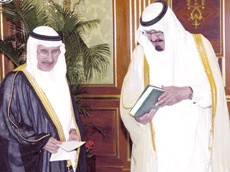
“The government is making efforts to remove the factors hampering the flow of investment,” the king said while receiving the 41st annual report of the Saudi Arabian Monetary Agency (SAMA) for 2004. He said the government was regularly revising its investment policies and regulations.
Spelling out the country’s major economic achievements in 2004, SAMA Governor Hamad Al-Sayari said the Kingdom had achieved a record budget surplus of SR107 billion last year as a result of soaring world oil prices. He said the Kingdom’s gross domestic product (GDP) grew by 5.3 percent last year.
In a statement on the occasion, King Abdullah reaffirmed the Kingdom’s resolve to go ahead with its reform programs in order to achieve continuous progress and prosperity. He emphasized the government’s policy of increased spending on long-term productive projects that promote prosperity of its citizens, create job opportunities and strengthen the economy.
The king praised SAMA’s role in drafting and carrying out the Kingdom’s fiscal policies in order to achieve monetary stability, strengthen confidence in Saudi riyal, create an economic atmosphere free of inflation and ensure adequate liquidity to meet development requirements.
King Abdullah also praised the remarkable progress achieved by Saudi banks, by strengthening their financial position and improving their services, matching international standards.
Presenting the SAMA report to the king, Sayari predicted that the Kingdom’s economy would achieve strong growth this year and in the coming years. “The Kingdom’s balance of payments registered a record surplus of SR194.7 billion in 2004,” Sayari said. Finance Minister Dr. Ibrahim Al-Assaf and other top SAMA officials were present during the meeting.
Sayari said during 2004 the Kingdom achieved high economic results in various sectors, for the third consecutive year, thanks to the economic reforms introduced by King Abdullah. “The national revenue grew by 16.8 percent and the actual gross domestic product increased by 5.3 percent in 2004,” he said, adding that there was substantial increase in monetary supply and bank loans. “This again shows the dynamic role of the private sector,” he pointed out.
The Saudi economy is now in a good position heralding a bright future, Sayari said and stressed the stability of riyal’s exchange rate with other currencies. “The cost of living index rose by only 0.3 percent during 2004,” he noted.
Sayari remembered the late King Fahd during his presentation and said King Fahd’s reign witnessed “the strengthening of Saudi economy, activation of the role of the private sector and increasing prosperity of citizens.”
Sayari said a number of international financial organizations had praised the Kingdom’s economic performance as well as its economic policies. He also noted the government’s efforts to protect the economy from the negative effects of world oil market fluctuations.
Last year, while he was crown prince, King Abdullah announced that the government would set aside SR41 billion from the 2004 budget surplus for development projects which have direct bearing on the welfare and prosperity of citizens. He said that a lion’s share of the surplus from rising oil prices would go for the repayment of public debts estimated at SR600 billion.
Saudi Arabia is expected to register a huge budget surplus in 2005. The Samba Financial Group has predicted that the Kingdom’s real GDP growth will be 6.5 percent in 2005 and oil export revenues will be SR589 billion. The budget surplus will be SR191 billion.
Samba’s Chief Economist Brad Bourland told Arab News that “the oil market has been stronger than anticipated in the third quarter. I may revise estimates upward slightly for 2005.”
Riyad Bank also expects the GDP growth of 7.6 percent, a budget surplus of SR176 billion and a current account balance of payments SR244 billion this year.
Estimates of the International Monetary Fund (IMF) show that Saudi Arabia will post a 4.1 percent GDP growth in 2005 and 3.3 percent in 2006. Current account balance of payments (as percent of GDP) will be 27.7 percent this year and 25.1 percent next year.