
JEDDAH, 9 September 2006 — Tackling the rising tide of Islamophobia in the West is one of the four main points to be taken up for discussion at the Seventh Session of the Islamic Conference of Information Ministers that begins in Jeddah on Wednesday.
The conference will be preceded by a two-day preparatory meeting of senior information officials from the Organization of the Islamic Conference (OIC) member states. It begins at the Jeddah Conference Palace today.
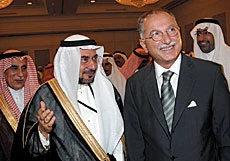
Addressing a joint press conference at Jeddah Crowne Plaza last night, Culture and Information Minister Iyad Madani and OIC Secretary-General Ekmeleddin Ihsanoglu said: “The conference aims to come up with a joint action to face up to the challenges of our time, especially with the rise of hate crimes and Islamophobia in the West and the confusion resulting from the unfortunate mixing up of Islam with terrorism.”
Madani said Custodian of the Two Holy Mosques King Abdullah would inaugurate the two-day conference.
“That in itself indicates the seriousness with which the Kingdom’s leadership is taking this conference,” said Ihsanoglu. “It is hugely significant coming as it does at a very critical time in the history of Muslims.”
Ihsanoglu said the conference was in a sense a continuation of the Makkah Summit in December last year.
“The conference will take into consideration the spirit of the Makkah Summit which called for the need to boost solidarity in action within the framework of the OIC and to implement the resolutions of that summit,” he said.
Madani said the International Islamic News Agency (IINA) needed to be recast to meet today’s needs. “It has outlived its purpose and we need to re-establish it with a new focus,” he said.
The Saudi information minister said each OIC member country has its own rules governing the conduct of the media. They basically serve their own national interests, he said.
“The idea is not to scrap everything and come up with a totally new policy,” said Madani. “We want to focus on the best and relevant aspects of each country’s media policy and combine them so that it becomes the benchmark for all other OIC member countries to follow.”
He said the conference of information ministers would only discuss four main proposals because “there is no point in discussing everything and not implementing anything.” In the past very many resolutions were passed but they were not implemented, Madani said.
Ihsanoglu nodded in affirmation. “We need practical steps,” he said. “And this conference aims to put those steps into practice.”
Madani said there was no need to be apologetic when dealing with the West. “We need to communicate with them. We don’t have to apologize. We need to come up with effective ways and means of communication among ourselves first and then with the outside world.”
The minister said media establishments in the OIC member countries are responsible for developing the media. “The media in the Muslim and Arab world are dependent on the foreign media because they are the most active, reporting from the centers of conflict,” he said. “Arab and Muslim media establishments should support their employees and make available the facilities and tools for them to report from conflict zones.”
Madani was blunt in his scathing criticism of the media in the Arab and Muslim world. “In Bosnia, in Nigeria, in Mindanao, did any of the Arab or Islamic media people go there?” he asked. “Our media establishments lack fieldwork. I don’t mean any offense, but coming to attend this press conference and reporting about it in the newspaper tomorrow is the easiest thing. The difficult part is to go to Mindanao to cover a major catastrophe.”
He said people keep talking about the freedom of the press. “Freedom requires responsibility and responsibility requires a proper code of conduct. The Arab and Muslim world needs to have a proper and effective code of conduct and ethics to govern its media.”
At the conference, Ihsanoglu will present a report on the implementation of the paragraph related to information in the 10-Year Program of Action to face the challenges of the Muslim Ummah in the 21st Century which was adopted at the Makkah Summit.
Among the main points which will be covered by the report are: how to effectively interact with the foreign media to enable the Muslim world to present its perspective; the adoption of a binding code of conduct that takes into consideration diversity and pluralism and protects the values and interests of the Ummah which should be adhered to by the media of the member states; and evaluation of the current situation of the OIC information system to consider ways and means on how to reactivate and energize the role of the media within the framework of the OIC.
The last meeting of the OIC information ministers was held in Cairo in 2003.

