RIYADH, 20 April 2006 — British Foreign Secretary Jack Straw said yesterday he did not believe the United States would use force against Iran over its nuclear program. “I am not going to discuss hypotheses which I do not believe are going to arise,” Straw said when asked what Britain’s position would be if Washington were to take military action against Tehran.
The United States has “not taken any option off the table, but in practice, both President George Bush and Secretary of State Condoleezza Rice say they are pursuing the diplomatic option as vigorously as the Europeans, Russia and China,” he stated.
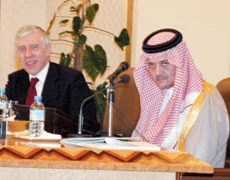
Straw was addressing a joint press conference with Foreign Minister Prince Saud Al-Faisal after they opened the second Saudi-British conference, “Two Kingdoms’ Dialogue,” at the Royal Conference Palace yesterday.
Saudi Cabinet ministers, British Ambassador Sir Sherard Cowper-Coles, leading Saudi and British businessmen and the governor of the Saudi Arabian General Investment Authority, Amr Abdullah Dabbagh, were among those present.
The press conference covered a range of issues including election of Hamas and its aftermath, the situation in Iraq, the fight against terrorism and the difficulties over Iran’s nuclear program.
In his remarks, Prince Saud made a proposal for setting up a joint investment holding company with participation from the private sector in both countries. He said such an initiative would go a long way toward boosting bilateral investment. He said British investment in the Kingdom stood at SR4 billion and was set for further growth in the climate of economic and political stability that Saudi Arabia enjoys. The prince’s proposal was welcomed by Straw, who commended it to the attention of the business communities in the Kingdom and UK.
Straw also agreed with Prince Saud that bilateral relations were healthy on the economic and educational fronts. The procedure for issuing visas for the UK has been streamlined and as a result, 90 percent of visas are issued within 24 hours.
The British foreign secretary said he strongly agreed with the statement of Custodian of the Two Holy Mosques King Abdullah who rejected the idea of a “clash of civilizations.” He mentioned the recent speech by Prince Charles at Imam Muhammad ibn Saud Islamic University in which the prince called for peaceful coexistence and dialogue as the only way to resolve differences.
Referring to the Kingdom’s fight against terrorism, Prince Saud spelled out the various measures that Saudi Arabia had taken against terrorists and to dry up their sources of funding. He also mentioned the initiative of King Abdullah who, as crown prince, floated the idea of setting up an international center for combating terrorism. He hoped that Britain would lend its support to the Saudi initiative. Straw, while acknowledging the Kingdom’s fight against terror and its support to his country during the 7/7 terrorist attack in London, did not comment on the idea.
On Hamas’ victory in recent elections and the suspension of financial aid to the Palestinian government, Prince Saud said this amounted to collective punishment of the Palestinian people. He noted European resistance to Nazi occupation during World War II and implied that Palestinians were similarly resisting Israeli occupation of their territory.
Straw, while acknowledging that Hamas came to power in a democratic election, reiterated Britain’s view that it should recognize Israel and renounce the use of force before the international community could continue its financial aid.
“Hamas should not equivocate on this issue and continue to condone acts of terror,” he said, referring to the bomb attack in Tel Aviv on Monday in which nine people were killed.
He argued that terrorism could not be justified under any circumstances, adding that terrorist forces were mistaken if they believed that their actions could cause the anti-terror coalition to break up. On the contrary, it would strengthen the alliance, he said, pointing to the Saudi-British stance as a shining example of unity in the face of terrorist attacks.
On Iran’s efforts to divide the United States and its allies in their bid to halt its disputed nuclear program, the foreign secretary said it had had the opposite effect. “At each stage they (the Iranians) have calculated they can split the international community ... They have simply ended up with an international community more united in its concern to ensure full compliance by the Iranians,” Straw said.