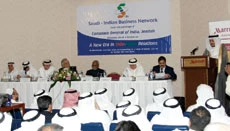
JEDDAH, 11 May 2006 — Saudi Arabia and India have always had historic relations but then they suddenly stopped looking at each other. Now is the time to rediscover each other and benefit from the good that the two countries have to offer. This was the conclusion of a well-attended seminar organized by the Saudi-Indian Business Network at the Jeddah Marriott last night.
The seminar participants included Jamia Millia Islamia Vice Chancellor Professor Mushirul Hasan, Professor Abubakar A. Bagader, deputy minister for culture and information, Khaled Almaeena, editor in chief of Arab News, Rashad Husain of King Abdul Aziz University (KAAU) and Mazen M. Batterjee, vice chairman of the Jeddah Chamber of Commerce and Industry. India’s Ambassador M.O.H. Farook presided over the seminar and Consul General Ausaf Sayeed was the moderator.
The subject of the seminar was titled “New Era in Indo-Saudi Relations” and most of the speakers said that a new era had indeed dawned for further strengthening the bilateral ties following Custodian of the Two Holy Mosques King Abdullah’s visit to India in January.
Professor Bagader said: “Contacts between Arabs and India date back to the pre-Islamic period and there is tremendous scope to further promote these ties.”
He said the Kingdom’s relations with India were not limited to Indian Muslims.
“We don’t differentiate between Muslims and non-Muslims. Everybody lives in perfect harmony here,” he said, adding that Islam was a full-fledged Indian religion and that Indian Muslims should be proud of it. He pointed out that pioneering research works in Arabic have been provided by some of the greatest Indian scholars.
Saud Islam, board member and director general of Yanbu Cement Company (YCC), highlighted his company’s 30-year-old partnership with India’s Associated Cement Companies (ACC). “This association has proved fruitful and mutually beneficial,” he said. “It can be a fitting model for other Saudi companies. The long interaction with the Indian company and its people coupled with visits to India has given us the opportunity of understanding India and Indians in a much better way.
“Indians have a high degree of competence, confidence and knowledge. The skilled category of technicians is very productive, competent, hardworking and dependable. Indians demonstrate a high degree of adaptability and adjust well with their Saudi colleagues. Their proficiency in English and knowledge of Arabic is an added advantage. They respect the laws of the country.”
Almaeena said it is time for the two countries to look at each other without the prism of a third country. “Let us not become victims to the machinations of those who have vested interests in keeping us apart,” he said. “It has to be a one-on-one relationship. We have to shake this image of India that we’ve seen in the old Indian movies. India has changed and so has Saudi Arabia. We want to cultivate good relations with this Asian giant. We need each other’s help on the world stage, be it with the United Nations or any other world body. Indians will have to stop looking at us as merely the supplier of oil; this has to be a partnership of equals. We need an academic interface to take this relationship to a new level.”
Almaeena added that the mindset has to change.
“It’s about time that we stop learning about India from a New York Times report,” he said. “The ice has melted and the ground has been broken by the king’s visit to India. All of us have to play a positive role.”
Mushirul Hasan said: “India is a liberal secular democracy. And these three aspects have been ‘the’ most important aspects of the country’s growth. The developments have led to the empowerment of women and all sections of society. Everybody has a stake in the country’s governance and therefore if I were a politician I would ask Saudi businessmen to invest in India because it’s safe.”
He suggested the establishment of an Arab Cultural Center at his university. “This will be one way of enhancing cooperation in the field of education,” he said.
KAAU’s Rashad Husain recalled his visit to India before King Abdullah’s recent visit and said he could see good opportunities for bilateral cooperation.
“India can help us in the field of education, both at school and university levels,” he said. “If our children can go to Jordan, Egypt, Sudan and other countries, why not India that has some of the best educational institutions and universities?”
Mazen Batterjee said three S’s could describe the success of India: “Sincerity, skills and simplicity.”
Sayeed, who moderated the seminar, said the king’s visit had set a new tone for the relationship between the two countries. He acknowledged that tremendous response from all sections of Saudi society in taking the relationship to greater heights.