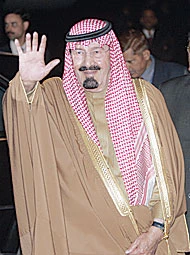
JEDDAH, 21 October 2006 — Custodian of the Two Holy Mosques King Abdullah yesterday issued a new succession law that would facilitate smooth transfer of power and remove the uncertainty caused by the inability of a king or crown prince to run the affairs of the state as a result of poor health.
Under the law, which has been applauded by Saudis and expatriates as a significant political reform introduced by King Abdullah, a committee of senior princes would be appointed to select future generations of kings and crown princes.
The new law, which will not be applied to the present king and crown prince, aims at streamlining the succession process. The law, which has 25 articles, offers a new mechanism for declaring the reigning monarch or heir to the throne unfit to exercise their powers, temporarily or permanently.
The new high-power committee, named the Allegiance Commission, will comprise the sons and grandsons of King Abdul Aziz, the founder of the Kingdom, the Royal Court said in a statement. The statement did not specify the size of the commission, which will be chaired by the oldest son of King Abdul Aziz.
The commission was formed by changing Article Five of the Basic Law of Governance.
“The invitation to pledge allegiance to the king and the selection of the crown prince will be made in accordance with the law of the Allegiance Commission,” the Royal Court said.
Under the law, the commission will have a say in the appointment of a crown prince proposed by the king. If the commission rejects the nominated crown prince, it would vote to choose between the king’s candidate and its own for the title.
The appointment of the new crown prince must be done within 30 days of the accession of a new king, the statement said. All meetings of the commission must be held behind closed doors.
The commission will set up a transitory ruling council, which would take over the running of state affairs for a maximum period of one week if neither the king nor the crown prince were fit to rule the country.
The transitory ruling council will not have the power to dissolve or reshuffle the government or the Shoura Council or amend the Basic Law of Governance, the Council of Ministers Law, the National Security Council Law or any other laws that are linked to the rule. The council should also protect the state’s unity as well as its internal and external interests.
While issuing the new law, King Abdullah said it was adopted to protect public interest. He also appointed Khaled ibn Abdul Aziz Al-Tuwaijeri secretary-general of the commission. Abdullah ascended the Saudi throne in August 2005 following the death of King Fahd after a prolonged illness.
King Abdullah also set up a medical committee made up of five members, three of them doctors, to pronounce on the ability of the king or crown prince to continue his duties. The committee includes the supervisor of royal clinics, the medical director of King Faisal Specialist Hospital and three medical college deans.
“Once the commission is convinced that the king is not capable of carrying out his duties for health reasons, it would ask the medical committee to prepare a report on the king’s health condition. If the report proves that the king’s inability to exercise powers was of a temporary nature, the commission would certify that and the power would be temporarily transferred to the crown prince until the king recovers,” the law said.
If the king informs the commission’s chairman in writing that he has recovered and if the body is convinced about that, it will authorize the medical committee to prepare a report on the king’s health within 24 hours. “If the medical report proves that the king is capable of exercising his powers, the commission will certify that and then the king will resume his powers,” the law said.
“On the other hand, if the medical report proves that the king’s inability to exercise his powers was a permanent one, the commission has to certify that and invite the crown prince to take over as the king of the country after receiving pledges of allegiance and these procedures must be carried out in accordance with this law and the Basic Law of Governance and this should be done within 24 hours,” the law said.
“If the commission finds that both the king and the crown prince are not capable of exercising their powers for health reasons, it will ask the medical committee to prepare a report on the health conditions of the two, and if the report proves that their inability was a temporary one, the commission will certify that. In this situation, the transitory ruling council will take over administration of the state’s affairs and take care of the interests of the people until one of the two recovers,” the law said.
“If the king or the crown prince informs the commission in writing that they have recovered and if the body is convinced about that, it will ask the medical committee to prepare a report within 24 hours. If the report proves that any of the two is capable of exercising his powers then the commission will certify that and then only he resumes exercising his powers.
“If the medical report proves that their inability was permanent, then the commission should certify that and then the transitory ruling council will take over administration of the state,” the law said, adding that the commission should select the best among King Abdul Aziz’s sons or grandsons within seven days and call him to take over as the king of the country.
The commission is also given the power to select the best candidate for the top post from King Abdul Aziz’s sons and grandsons if the king and the crown prince die on the same day. The transitory ruling council will then take over administration of the state until a new king ascends the throne.
Muhammad Al-Zulfa, a member of the Shoura Council, said the new law would ensure that only the eligible sons of King Abdul Aziz would get to rule the country. “It will bring inner peace among members of the royal family and among citizens. The system is clear now,” he told Al-Arabiya satellite channel. “This is a turning point that will ensure the continuity of the ruling family,” Zulfa said. “King Abdullah has made this decision at a crucial time. The Kingdom is going through a phase of change and development and he wanted society to be in safe hands in the future.”
Saleh Al-Tayar, secretary-general of the Arab-French Chamber, said the decision reflected the king’s desire to achieve a smooth transition of power in the country, in tune with modern democratic norms. He said the appointment of the medical committee to give its word on the ability of the ailing king or crown prince to run the affairs of the county would solve many problems.
Majdi Kurdi, a legal consultant, said the new law would remove the shortcomings in the existing succession system. Under the previous system, the power was transferred to the oldest son of King Abdul Aziz, regardless of his age and ability to run the country’s affairs. He said the Kingdom was making steady progress toward democracy. “I think that the Saudi royal family is the first to introduce this new succession system,” Kurdi said, adding that it would be followed by others.
According to the new law, the Allegiance Commission will include a son of the king and another of the crown prince. All members should be capable and well known for their uprightness and integrity. If any vacancy arises among the members, the king will make appointments to fill them in accordance with the law.
The Allegiance Commission will abide by the teachings of the Qur’an and Sunnah, preserve the state’s entity, and protect the Royal Family’s unity and cooperation, the national unity and interests of the people, the law said. The commission will be based in Riyadh and will hold its meetings at the Royal Court. Its members and secretary-general will take oath in front of the king before assuming their duties.
In accordance with Article Six, the commission will call for pledging allegiance to the crown prince as the king of the country, following the death of the existing king. After receiving the pledge of allegiance, the king can nominate one or two or three to become the crown prince and the commission will select the best among them for the title.
“If the commission rejects all the king’s nominees, it should make its own nominations for the title,” the Saudi Press Agency said quoting the law. “If the king rejects the commission’s nomination, it can vote on the king’s nominee and the commission’s nominee and the person who wins the most votes will be named the crown prince,” the law said.
Referring to the regular meetings of the commission, the law said it should be held with the permission of the king and should have a quorum of two-thirds of its members including chairman and his deputy. All members should attend the meeting and should not leave before the end of the meeting without the permission of the chairman. If anybody is unable to attend the meeting, he should inform the chairman about it in writing. A new subject can be included in the agenda with the backing of ten members and the majority must approve its decisions.