JEDDAH, 23 September 2006 — Saudi Arabia’s National Day, which is observed throughout the Kingdom today, is a celebration of its national unity, its outstanding role on the world stage as a major stabilizing force, and its progress and achievements in different sectors.
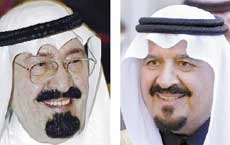
Emphasizing the significance of the National Day, Custodian of the Two Holy Mosques King Abdullah said it embodies Saudi Arabia’s strong adherence to Islam as a way of life and Shariah and its commitment to the values of justice and equality.
Abdullah, who became the king in August 2005 after the death of King Fahd, also reaffirmed his government’s resolve to go ahead with development programs. “We’ll continue our efforts to strengthen Arab and Islamic unity and work for achieving world stability and prosperity,” he added.
Over the past several decades, Saudi leaders beginning from King Abdul Aziz, the founder, to King Abdullah have been making tremendous contributions to take the country to new heights of progress and prosperity through their farsighted and visionary ideas and reforms.
Being the largest oil producer and exporter, Saudi Arabia plays a big role in stabilizing the international market by ensuring adequate oil supply. Recently the Kingdom announced plans to invest over SR262 billion ($70 billion) in its oil and gas sector over the next five years.
As part of its efforts to strengthen the economy, the government launched three major economic cities in Rabigh, Hail and Madinah in order to provide infrastructure facilities required for carrying out industrial, educational, information technology, real estate and other projects worth more than SR155 billion ($41.3 billion).
In a recent statement, Saudi Arabian Monetary Agency (SAMA) Gov. Hamad Sayari said the Saudi economy was continuing its strong performance as a result of suitable economic policies adopted by the government and soaring oil prices. He said the higher ratings given by international rating agencies such as Standard & Poor’s and Fitch would enhance investor confidence in the Saudi economy.
Since King Abdul Aziz established the modern Kingdom of Saudi Arabia in 1932, its transformation has been astonishing. Within a few decades, the Kingdom has turned itself from a desert nation to a modern state and a major player on the international stage.
During his unification campaign, Abdul Aziz captured all of the Hijaz, including Makkah and Madinah, in 1924 to 1925. In the process, he united warring tribes into one nation. On Sept. 23, 1932, the country was named the Kingdom of Saudi Arabia.
The legendary King Abdul Aziz (1932-1953) was a remarkable leader of imagination and vision who set Saudi Arabia on the road to modernization. He started building the country’s infrastructure as he established roads and basic communications systems, introduced modern technology, and improved education and health care.
His sons Saud, Faisal, Khaled, Fahd and Abdullah continued their father’s legacy, steering the country to greater progress.
King Faisal initiated the first of a series of economic and social development plans. He established the first public schools for girls. The Organization of the Islamic Conference (OIC), a group of 57 Islamic countries, was his brainchild.
King Fahd (1982-2005) had played a big role in boosting the Kingdom’s socioeconomic development and making it a leading political and economic force. He was central to Saudi Arabia’s efforts to diversify its economy and promote private enterprise and investment. He restructured the Saudi government and approved the first nationwide municipal elections, which took place in 2005.
King Abdullah, who ascended to the Saudi throne last year, is a cautious reformer and an ardent advocate of Arab and Islamic unity. He has supported women’s rights and empowerment by allowing them to take part in chamber of commerce elections and increasing their job opportunities.
Within one year in power, Abdullah has several major achievements to his credit. The Makkah Islamic summit, which was called by the king, was a resounding success as it approved a 10-year action plan for the overall development of OIC member countries and gave the world’s 1.5 billion Muslims new hope for a brighter future.
Abdullah initiated the National Dialogue forums two years ago to fight extremism and intolerance and set up the King Abdul Aziz National Dialogue Center.
“The forums organized by the center must deal with issues and thoughts, which citizens want experts to discuss,” the king said in a recent statement. “These forums bring together Saudi people and build bridges of contact and discourse between them,” he said.
Just three weeks after his takeover, King Abdullah ordered a 15 percent salary increase for all Saudi nationals who were government employees. In addition, more than SR80 billion ($21.3 billion) from the 2005 budget was allocated for educational, health, housing and other welfare and service projects. He also increased the maximum social insurance allocation for families from SR16,200 ($4,320) to SR28,000 ($7,467) annually.
King Abdullah won international recognition by launching an unprecedented crackdown on Al-Qaeda terrorists, blamed for a series of bombings and shootings across the Kingdom since May 2003. “We’ll flush out the deviants from the country, no matter how long it takes,” he insisted.
King Abdullah has traveled widely to strengthen the Kingdom’s relations with other countries, emphasize Riyadh’s position on various issues and mobilize support for Arab and Islamic causes, most importantly the Palestinian issue. Abdullah was successful in bringing Saudi-US ties back to normal. In April this year, Abdullah met US President George W. Bush in Texas and discussed major issues including Palestine and Iraq as well as ways of strengthening bilateral relations.
The Middle East peace plan endorsed by the Arab League summit in Beirut was originally proposed by Abdullah to resolve the Arab-Israeli conflict. His peace proposal offers Israel normal ties with Arabs in exchange for full withdrawal from all Arab land occupied in the 1967 Middle East War.
“We presented this peace plan in order to refute Israeli claims that Arabs were not students of peace but that they were students of war,” the king said in an interview with Kuwait’s Assiyassa newspaper recently.
Inside the Kingdom, Abdullah has become popular through implementing welfare and investment projects, introducing new political and economic reforms and taking steps to fight poverty.
A humanitarian king, Abdullah was the first to visit poor neighborhoods in the capital city two years ago and to launch a series of schemes to fight poverty in various parts of the country. He allocated SR2 billion from the budget surplus to build low-cost housing units for the poor and needy in various parts of the Kingdom.
King Abdullah this year announced a major scholarship program for Saudi students to pursue their studies abroad. According to the plan, 15,000 students will be sent to the United States and 3,000 to Asian countries for higher education.
“This is the largest scholarship program in the Kingdom’s history,” said Higher Education Minister Dr. Khaled Al-Anqari in a statement.
The king also approved plans to raise monthly stipends given to Saudi students by 15 percent. Measures have also been taken to solve the problem faced by some students abroad as a result of exchange rate fluctuations of the Saudi riyal against other currencies.