JEDDAH, 4 October 2006 — Foreign Minister Prince Saud Al-Faisal yesterday called upon the United States to revive the Middle East peace talks to end the Palestinian-Israeli conflict, which he described as the “core problem” triggering violence in the region.
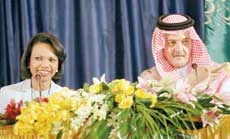
“Resolving of this conflict would have a positive impact on all other crises in the region, including Iraq and Lebanon,” Prince Saud said addressing a joint press conference with US Secretary of State Condoleezza Rice.
“It is hoped that the United States will restart the peace process and lead the region to peace and stability,” he said.
On her part, Rice called on the Palestinians to stop their infighting that has claimed the lives of 12 people in the last two days.
“Innocent Palestinians are caught in the crossfire and we urge all parties to stop,” she said in reference to recent confrontations between Hamas and Fatah.
Rice, who goes on to visit Egypt, Israel and the Palestinian territories, said the Palestinians needed a government committed to already existing international frameworks for peace talks, including recognition of Israel and renunciation of violence. Regarding Iran’s nuclear program, the US secretary said the international community would have no choice but to impose sanctions on Iran if it fails to suspend uranium enrichment.
Rice restated that the United States had no indication that Iran intends to suspend enrichment. She said the five permanent members of the United Nations Security Council plus Germany would consult “shortly” on Iran.
“We are continuing to hope that Iran will suspend its enrichment activities but we have no evidence that it is (going) to do so,” she said.
“Should it not, then the only choice for the international community is to live up to the terms of Resolution 1696,” she said.
The resolution threatens sanctions against Iran if it doesn’t cease uranium enrichment until a negotiated settlement ensures that Iran’s nuclear program is solely for energy purposes.
Prince Saud said that the Kingdom placed a high priority in making the region free of weapons of mass destruction, including nuclear weapons.
Regarding the situation in Lebanon the two officials held talks, reassuring the importance of achieving stability, security and supporting the legitimate Lebanese government in total control of the country.
Prince Saud called the situation in Iraq “dangerously escalating,” and said he hoped the current national reconciliation program would help defuse the growing crisis. He also alluded to a recent agreement among Iraq’s nine neighbors to bolster border security without “interfering in internal matters”.
Rice met Monday evening with Custodian of the Two Holy Mosques King Abdullah in what she described as an extensive and fruitful discussion.
Rice said there is a “desire to resolve the political crisis” in the Palestinian territory toward a two-state solution and based on the Arab Peace Initiative proposed by then Crown Prince Abdullah in March 2002.
The initiative asks Israel to pull out of the Occupied Territories, including the Golan Heights, and establish a Palestinian state with East Jerusalem as its capital. In return, full diplomatic relations with Israel would be restored and the country would be treated as an equal partner in the Middle East.
She said that although Hamas was elected, it has been unable to deliver to the Palestinian people and join the consensus of the Arab world for a better life through the road map to peace, which also calls for a Palestinian state but is less specific as to its boundaries, and the Arab Peace Initiative.
However, Rice laid the blame squarely on the Palestinians for not creating a government that the “international community” could trust.
“They should make a choice,” said Rice. “Under the circumstance they cannot represent a responsible government for the international community.”
She urged Hamas to commit to the road map and the Arab Peace Initiative and all the international documents accepted by the Palestinians before. Rice also called for talks between President Mahmoud Abbas and Israeli Prime Minister Ehud Olmert.