
MAKKAH, 4 October 2006 — Severed limbs, horrific disabilities and alarming deformities are just some of the horrid sights pilgrims in Makkah have to face in and around the Grand Mosque. Beggars have a tendency to capitalize on the sanctity of Ramadan — the month of fasting and charity — using it as the perfect time to elicit people’s sympathies to make a fortune.
The Makkah municipality has set up the Anti-Beggary Department to battle beggars around the Grand Mosque. The committee has been successful to some extent in eliminating the problem within the Grand Mosque itself, and now they are directing their efforts to fighting the difficult problem on roads around the Holy Mosque.
Mansour Al-Hazmi of the Anti-Beggary Department explained that his department has been successful in arresting many beggars with disabilities. “All the beggars have told us that they were forced by an organized gang to beg or else they would be killed. Children said they have had their limbs amputated back in their home countries because they feel it is more profitable to beg with severed limbs.”
Al-Hazmi added that many of the pilgrims that had arrived in the Kingdom for Umrah had not come to Saudi Arabia for pilgrimage but rather for begging.
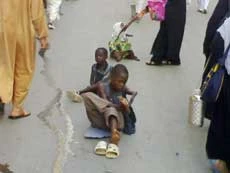
Wanting to see begging first hand, I went down the Al-Hajla Road that leads to the central Haram area. I noticed groups of young African children with disabilities lined up on the sides of the road. Many had missing arms and legs. In their torn and dirty clothes many of these disabilities could be at best described as disgusting if anything.
The children were lined up in a systematic way straight bang in the middle of the sidewalk and in the way of people. The children were singing songs in chorus about begging and how people should give them money. It is noticeable that when people empty the streets to pray in the Grand Mosque, the children remain in the same place so as not to lose their positions. When the crowds come out of the Grand Mosque, the children remain steadfast in their positions forcing people to walk round them and thus being in a prime position to beg.
I went to a nearby mosque for Asr prayer. After prayer, I went out to see people begging. Those with legs were running after worshippers and showing their disabilities to gain sympathy. Feeling sorry for them, people gave them charity. As soon as a person reaches into his pocket to give money, other beggars rush round the person to get their share of the money.
If someone refuses to give charity, then the beggars shake their severed and disabled limbs to disgust them and force them to either give money or hastily move on. Some people could be seen quickly giving money and then walking away fast.
As I observed all this I noticed that there were people (mainly men) sitting on the side of the roads watching. If the streets were full of African beggars, then those waiting on the side of the road would also be of the same nationality. If, however, the beggars were of Asian nationality then the ones waiting on the side of the road would be Asians.
Thinking that they might be officials from the Makkah Municipality or secret police, there was only one way to find out and know who they were. I went to one of the child beggars who was begging and had gathered a large amount of notes in his hand. Quickly I rushed toward him snatching the money and trying to look for a getaway when all of a sudden within a matter of 15 seconds I had been cornered by the men standing on the side of the road. They had gathered around me in a way that would not cause suspicion among other pedestrians. They mishandled me into a back alley and one of the men took the money off me. Alarmingly, I noticed that one of them was armed with a screwdriver that he had hidden up his sleeve. A third person asked me for my wallet and the men walked away. They emptied SR320 from my wallet and threw the wallet in a rubbish bin close by. It was then that I realized that these men were part of the gangs protecting the beggars.
One hour before iftar and after having been systematically robbed, I continued on another road leading to the Holy Mosque. I noticed women of Asian and Arab nationalities begging. Some were carrying children. They were begging and looking around fearing that officials from the Anti-Beggary Department might come from behind to arrest them. If a person ignored their requests for money then the Arab beggars would be rude and would push them away cursing them and even sometimes spitting at them.
Iftar time came and I broke my fast in the courtyard outside the Grand Mosque. I went back quickly to the locations which I had earlier visited and found that there were no beggars around. I guessed it was break time for them so I decided to wait and see what would happen. Before Isha and at a time when people were getting ready to take the road to the Grand Mosque, I saw the same African people that took my money and nearly beat me up. They were carrying children and lining them up on the road.
Many questions came to my mind. Who are the ring leaders? Who are the people that are exploiting the children and how big is their gang? Why are there no other children on the same road? Where do they come from and where do they stay in Makkah?
The answers are simple. They belong to an organized crime network that exploits them to make money. According to a security source, these children are deliberately handicapped in their home countries before being sent to the Kingdom. The children are merely brought to the Kingdom for monetary reasons.

