JEDDAH, 8 October 2006 — With a view to connecting people of Jeddah with their history, the Culture and Tourism Department at the Jeddah municipality has organized a daily historical fest with singers and people dressed in colorful costumes and other eye-popping dances in the city’s downtown Balad district.
Nassif House, the most famous house in Balad district which is also home to a museum, is the venue of the colorful exhibition that runs till the end of the month. Visitors are being entertained with performers singing songs, playing Hijazi games and making vocal presentations using Hijazi accents together with words that have died out. Organizers say the event is also aimed at showing people what life used to be like in Old Jeddah.
Sami Nawar, head of the Culture and Tourism Department, said the event would be taking place everyday after Taraweeh prayers. “This event is very important to show the real heritage and culture of the Bride of the Red Sea. We also have a special program during the Eid vacation where we will stage traditional songs performed by famous Hijazi bands. We are also organizing a number of shows and plays across the downtown area and also around Jeddah.”
Young Saudi boys who live in the serpentine alleys of Balad perform at the event. The boys were encouraged by the Cultural and Tourism Department to perform at the event. All of them were taught traditional Jeddah games and given elocution lessons in how to speak in the Old Jeddah accent.
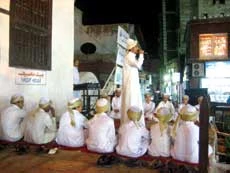
The show is taking place at a small stage-like balcony at the entrance of Nassif House. It begins each night with the singing by a traditional singer known as a Jassees. The Jassees at Nassif House performs solo using his voice as an instrument combining both the tune and the words. The Jassees’ voice is amplified through the area via a speaker system.
Jasseeses traditionally sing at weddings and are reputed to begin by praising Allah and his Prophet (peace be upon him) and then the bride and the groom in a music scale that is peculiar to the region. Each night the Balad area is being enthralled by the voice of the Jassees as spectators, shoppers and shopkeepers sing along in chorus with the Jassees.
Spectators are also entertained by a real-life kuttab (the traditional school), where students used to sit on the ground around their teachers using a bench to place their books on and learning their lessons by rote. Young boys and a man reenact life in kuttab classroom and even sing the Arabic alphabet in a musical manner.
In bygone days, the kuttabs were known for the harsh punishment meted out to misbehaving and lazy pupils. In one scene reenacting the “falaka” method of punishment, one boy acted as if he could not memorize the lesson and so the teacher called on other pupils to hold him to the ground and hold his feet up. The teacher then pretended to hit him on the soles of his feet using a wooden stick.
Ramadan in the Hijaz was renowned for the Musaharati — a group of people who would wanders the streets before the time of sahoor to wake people up to eat. In order to show people how this was done, a group of men imitated the Musaharati wearing traditional clothes and walking around saying, “Wake up you who are sleeping and praise Allah.”
The scene at Nassif House has been an entertaining one with groups of people interacting with the crowds asking cultural questions about Old Jeddah. Spectators with the most knowledge about the history of the city were also awarded gifts.