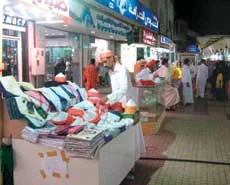
JEDDAH, 13 October 2006 — Downtown Jeddah, also known as Al-Balad, has always been a place where Ramadan festivities concentrate. One of the traditional fixtures of this scene among the Old Arabian buildings of the city’s historic center has been the stalls selling traditional foods for breaking the daily fast during the holy month.
Stalls managed by men in traditional Hejazi garb can be seen stirring sizzling platters of chopped liver and onions or serving up cups of balilah, a dish mostly comprising chickpeas.
But the scene on Qabil Street, one of Balad’s most scenic and lively pedestrian areas — a walkway paved with century-old tiles flanked on both sides by shops and cafes — has changed dramatically this year.
“She sold her license to an Indian man who is now selling sneakers in a place where I had been selling balilah for the past seven Ramadans,” complained downtown shop owner Ahmad Al-Shihri, referring to a woman who, under a new municipal licensing plan, had been given the space to sell her wares.
The policy, which went into effect for the first time this year, is aimed at offering employment opportunities to disadvantaged Saudi women. However, as Al-Shihri and other vendors point out, many of the women who were given licenses ostensibly to set up their own festive Ramadan stalls are selling their licenses to Asian expatriate street vendors. Subsequently, instead of selling Ramadan treats that give a festive air to the historic center during the holy month, these vendors are simply selling knockoff sneakers and watches, cheap apparel items and trinkets, and other typical wares sold on city streets the world over.
“This is a sad scene,” said Al-Shihri. “Previously we were all Saudis in this street representing Jeddah’s culture to visitors during Ramadan. Now the majority (of Ramadan street vendors) are non-Arab expatriates looking for fast and easy cash.”
Shop owners who in years past have set up decorated booths in front of their brick-and-mortar stores traditionally maintain the Ramadan street scene. Until this year, these shop owners were given priority in the issuing of Ramadan street-stall licenses. Not this year.
Qabil Street had about 25 balilah stalls last year in the main pedestrian zone. This year, there are about five Ramadan balilah stalls intermingled with dozens of street vendors selling non-seasonal items.
Muhsin Bin Hadi, a downtown Saudi businessman, said the lack of Saudi-operated seasonal stalls this year has clearly affected the flow and ambiance of visitors to the area. Previously, he said, people came in many cases solely for the balilah and fried liver and to hear the accents of the old Jeddawi vendors.
“They need to find a new method for helping needy women instead of giving them licenses to operate stalls,” said Bin Hadi, pointing out that because street vending has traditionally been a man’s job, many women aren’t used to or don’t feel comfortable being street vendors, which is why many have sold their licenses to others.
He also said he believes that many of these street vendors are undocumented migrants living and working illegally in the Kingdom.
Bin Hadi said that a Ramadan seasonal street vending license costs SR500 (about $133). He said that he’s heard of women selling their licenses to expatriate men for SR4,000 (about $1,067). “The municipality isn’t helping needy Saudi women as much as it has helped illegal expatriates to make huge money to send abroad,” he said.
Humaid Al-Hadi, who operates a fried-liver stall adorned with traditional decorative fabric, said he was shut out of the prime location he had in previous years.
He was selling his food a few blocks away from the main pedestrian zone, in a narrower alley branching off Qabil Street. He had hired some local children to hold up signs at the end of the alley to attract customers.
“We had no choice, the majority of the good places went to women, who sold them off to illegals,” said Al-Hadi as he stirred the liver and onions that sizzled in a large frying pan. “I can hardly attract customers because of my remote location,” he added.
At the spot Al-Hadi had used last year a Yemeni man was selling Saudi headgear on a table.