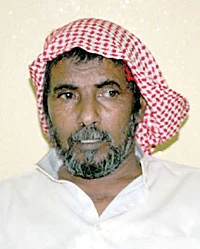
MAKKAH, 18 November 2006 — Abject poverty is enough to throw a man into the abyss of disappointment and despondency. But when such poverty is compounded by an all-embracing darkness, caused by gradually approaching blindness, the mental courage of any man, let alone a 60-year-old breadwinner for a Saudi family, will be seriously eroded.
One of Hasmad Al-Fahmi’s eyes has been irreparably lost while the second is steadily weakening. Other members of his family have also been the victims of glaucoma, an eye disorder marked by abnormally high pressure within the eyeball that leads to damage of the optic disk and, if not treated, causes impaired vision and sometimes blindness
His eldest son Sharif, 25, lost both eyes at the age of four while each of his other two sons, Abdul Rahman and Abdul Rahim, lost one of their eyes at the same age.
Fahmi’s wife can see with difficulty. His daughters can see only with the help of very powerful lenses and may lose their sight at any time. They suffer from a genetically-transmitted glaucoma.
Consultant and head of the Department of Ophthalmology at the Hira Hospital, Dr. Amna Fallata warns that neglecting to treat glaucoma, can lead to total blindness. She stressed the need for expert examination and treatment of Fahmi and his family so that their condition does not worsen.
The unemployed Fahmi is feeding his seven-member family with the help of a SR2,000 monthly allowance from the Social Welfare Department. He does not have money to treat the eye problems of his sons and daughters. It is with difficulty that he manages to pay the subsidized house rent and bills for other utilities such as water, electricity and cleaning. He has no money left to treat his sick family members. “Despite the hardships, I try to offer my children a good education which may help them have a better future,” Fahmi told Arab News.
Sharif, his totally blind eldest son, is studying Arabic at Umm Al-Qura University. His second son who is partially blind is also at the same university and his other children are at various levels of education.
“I am deeply worried about my apartment. Any arbitrary decision on the part of the housing authorities will evict us from the subsidized apartment and throw us into the street,” he said.
He is obsessed with this fear because some of his neighbors had been driven out of their homes once before. They were, Fahmi said, given new flats in another district after some time. He said that he would have peace of mind only if he were allocated a house under the King Abdullah Housing Scheme.