
I have eagerly waited for the publication of this anthology of modern Arabic literature. This literary feast offers the best fiction and short stories from the Arab World. For the reader unfamiliar with Arabic literature, this well crafted selection includes excerpts of novels and short stories of seventy-nine writers from Morocco to Iraq, from the 1930s to the 2000s. The truth is that until Naguib Mahfouz, the first Arab writer to be awarded the Nobel Prize in Literature, Arabic literature was, by and large, unknown. Furthermore, Denys Johnson-Davies points out in his excellent introduction that “until very recently Arabic was studied in the West as a dead language, much like Latin and Greek. The small band of Arabists were happier surrounded by piles of dictionaries with a poem written in pre-Islamic times than they were with a modern short story.”
Egyptian authors dominate with thirty-nine authors, which is perfectly understandable since the renaissance of Arabic literature took place in Egypt. This rebirth, however, was not solely confined to Egypt as writers from Palestine, Syria, Iraq, Lebanon, Sudan, Libya and the Maghreb also tried their hands at short stories and novels. The Egyptian writer Muhammad Husayn Haykal is credited for penning the first Arabic novel “Zaynab” in 1929. The editor remarks brilliantly that inventing characters and bringing them to live in an imaginary world of his creation was foreign to the Muslim Arab mind. The Thousand and One Nights is regarded as a masterpiece yet in the Arab world these colorful tales of fantasy were never given much consideration compared to poetry which remained until the twentieth century the supreme literary genre. “Had The Arabian Nights been held in higher regard by the Arabs themselves, it might well have given rise to a modern Arabic literature before Western literature made its mark,” concludes Johnson-Davies.
Although Arab authors often describe unfamiliar backgrounds, their talent brings out a universal appeal in their works.
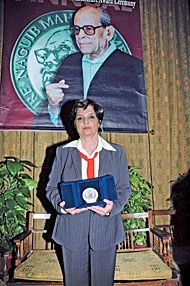
This was certainly the case of the Nobel Prize winner Naguib Mahfouz and the same can be said of the Palestinian-born writer Sahar Khalifeh who has just received the award of the 2006 Naguib Mahfouz Medal for Literature for her novel “Sura wa Ayquna wa ‘Ahdun Qadim” (The Image, the Icon, and the Covenant). In their citation the judges said that Khalifeh posits the difficult and complex Palestinian question through unconventional characters whose search for existential answers remain outside the bounds of politics through love and bitterly aborted human relations. Her unique literary genius is founded on the intricate relationship between the historical and the aesthetic. The historical is the struggle of the Palestinian people and the aesthetic is their beliefs, their traditions, and their mythical and spiritual legacy, both oral and written.
In her address, Sahar Khalifeh explains how she discovered that literature “was not an ornament that we hang on the entrance to our house or a decoration on our head. Rather, literature is a more profound feeling: A feeling for the earth itself, the streets, people and their problems, the bullets and the bombs of the occupier, the victims, and the blood of freedom fighters. But it is also love, and hope, the compassion of the heart, the splendor of the soul, and the resistance to gloom with the wings of our dreams.”
The editor has chosen for this anthology a moving excerpt from Wild Thorns — one of Khalifeh’s first novels, which describes life in the Israeli-occupied West Bank. There is an interesting story behind this novel. According to Sahar Khalifeh, Dr. Hanan Ashrawi, her teacher at Birzeit University, suggested that she submit this novel to the Arabic Department in exchange for the one remaining credit hour for her graduation. Although the novel had already been published in three languages she was given a D! The Head of the Arabic Department thought the novel was second-rate and that it fell way below the standard of any kind of literature. The novel is about Usama, a young translator who returns home from the Gulf to join the fight against Israeli occupation:
“A mist of poetry seemed to hover above his head. Why are we so moved by songs of loss? Are we a nation of romantics? Well, not any more. Love lying broken at your feet makes your soul a commodity in the market of blood. But I’m here. On this earth, in spite of everything I’m here. And I’ll stay here... I’m here. I’ve returned. To this rock. To this hollow. And this hand stained with blood, is still a bridge of freedom over a river of pain... May the earth shake when I walk. May unheeding eyes watch me if I sleep. I’m moving toward the light along the dark paths of anger.
“He laced up his shoes and walked away whistling cheerfully.”
Just like Naguib Mahfouz has put Cairo on the literary world map, Ibrahim Abdel Meguid (The other Place, No One Sleeps in Alexandria, Birds of Amber) and Edwar Kharrat (The City of Saffron, Girls of Alexandria) have written about their home town Alexandria which has inspired many novelists and poets.
The following excerpt is taken from Al-Kharrat’s novel Rama and the Dragon, which was awarded the Naguib Mahfouz Medal for Literature in 1999: “This Sea City is my city, diffused in the high noon of its paved road... What is in your mind, Rama? A depressing, fragile sorrow or a void? The void of November noon? The winter void of my taciturn noon. My city escapes me: Fancies, people and their cars, traffic lights and horns, the rattle of trams and the eyes of the people buried in the secret of their troubles, all silent on the road. All disappearing in November clarity, in distant white clouds hanging on the city ceiling in Al-Raml Station. Nothing is left but your gaze, a secret I will never decipher.”
The AUC Press established the Naguib Mahfouz Medal for Literature in 1996. With over 80 new publications annually and more than 800 titles in print, the AUC Press is now recognized as the region’s leading English-language publisher.
My only regret is that too few literary works from the Gulf countries have been translated so far. The wealth of literary talent in the Kingdom and the Gulf countries has yet to be fully acknowledged.