
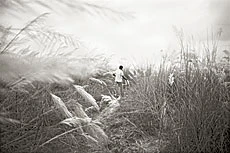
Saiful Haq Umi has been threatened, beaten and forced into hiding. But he refuses to bow to brute force, continuing to document the lives of victims of political violence in Bangladesh. And now, human rights activists are hoping the National Geographic Award Umi has just received will raise his profile enough to protect him from future reprisals.
Asif Saleh, founder of Drishtipat, a London-based human rights organization, said: “I couldn’t believe it when we met Saiful. Here was someone on the ground, doing fantastic work, unafraid of the consequences, this is huge… Now that he has been given the National Geographic award it may be harder for him to work, but maybe the exposure will help protect him.”
Over the last two years, Umi has felt firsthand the sinister intimidation tactics used by the militia to suppress the slightest protest against injustice. But the beatings don’t bother Umi; to him they are symptoms of a much more diabolical issue.
“The problem is in the violent policy of the ruling class toward their rural populations,” Umi said. “Violence is about more than a bullet in your head, it’s much wider than that. Walking into a father’s home and threatening to rape his daughters — that’s violence.”
Umi’s work eschews the violent reality of the victims’ physical wounds. The photo activist focuses his lens on their return to normalcy. It is difficult to ignore the sadness surrounding a woman who has been ravaged by multiple men for belonging to a certain minority. Her attackers gouged out her eyes when she recognized one of the men, taking his name and asking him to stop.
Umi portrays her gracefully in the context of her family life, concentrating on her maternal identity. His photographs share a poetic, dreamlike quality that tell the story of a people who have had the will thrashed from their fragile human forms, only to have hope return to their faces.
“I was amazed to see their smiles, to see that they had so much hope despite what they have been through, I was very moved,” said Umi, who completed a graduate degree in Applied Physics, Electronics and Communication Engineering and then realized he wanted more than a comfortable life “with a job, a good-looking wife and two kids.”
He found the higher purpose he was seeking with an organization called Counterfoto. He was always fiercely political and soon learnt how to wield a camera. When a panel of judges at The National Geographic Society saw Umi’s first project, they gave him one of six prestigious awards for 2006.
“He (Umi) is indeed an amazing photographer, storyteller and artist and we are very proud to have been able to feature his work,” said Eduardo Abreu, co-director of the photography award program at the National Geographic.
Umi is back in Bangladesh working on a project to document human rights abuses in another corner of the country that evades the attention of most foreign human rights monitors. With the help of Action Aid, Drishtipat and colleagues at Counterfoto, he is committed to forcing the world’s attention on atrocities that target innocent civilians in the name of one political cause after another.
To see more of Saiful Haq Umi’s work go to:
http://www.nationalgeographic.com/allroads