
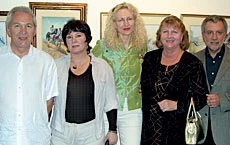
ALKHOBAR, 22 December 2006 — The sandals looked real enough to slip your feet into. The birds could easily have swooped down off the wall and around the room. And it would have taken just a bit of imagination to allow the children smiling out from one painting to go off running through the desert in a landscape pictured nearby. This is Saudi Arabia as seen through the eyes of British artists. The artwork has been gracing the walls of the drawing room at the residence of Terry Evans, head of the British Trade Office in Alkhobar. This latest exhibition gains its inspiration from a photography show that Evans hosted soon after taking up her new post in Saudi Arabia.
“I was very privileged earlier in the year to be able to exhibit part of the British Council ‘Images of Islam’ photographic exhibition,” said Evans. “This featured photographs were taken by Saudi artists on the theme of ‘Islam in the UK.’ The aim of the exhibition was to focus on the similarities between the cultures through art. The exhibition was only on my walls for a few weeks, but during that time I had a lot of favorable comments from visiting British delegations who passed through the premises.”
The ‘Images of Islam’ photographs on the walls of Evans’ drawing room created a good talking point at social functions and Evans decided that this cultural exchange should be continued. She contacted an Alkhobar-based British artist, June Ross, who has been involved with both the British and Saudi art community for many years in the Eastern Province, and asked for Ross’ assistance.
“I was really pleased that June was able to organize displays of artwork with a Saudi Arabian theme,” Evans said. “The work rotates every two months and gives different artists a chance to display their work. The criteria for displaying the artwork is that it is created by local, amateur artists with a prominent Saudi Arabian theme in the work.”
One might wonder why the head of a trade office would be interested in getting involved in the Saudi art scene, but Evens believes that creating greater awareness and understanding of the local culture can strengthen the foundation of cooperation from which trade initiatives grow.
“Most of my visitors are from the UK. They are here on business and they have tight schedules which means they very rarely get to see any of the desert landscapes or scenic aspects of Saudi Arabia outside the three main cities. The artwork forms a backdrop for meetings and receptions that I hold and allows me to introduce something other than a business perspective of Saudi Arabia to my visitors,” Evans explained. “This is important in giving people a broader view of Saudi Arabia, one that I hope they will explore further on return visits to the Kingdom. Although my job focuses on trade, I am very happy to work with the local community on diverse programs that bring benefit to all those concerned.”
Quite a good size crowd turned out to view the first exhibit which featured both paintings and photographs. The four British artists included in the show were Adrian Drummond-Hill, Angela Allen, June Ross and Robert Pollock. Drummond-Hill is quite a newcomer to the Alkhobar art scene, although he has lived in Saudi Arabia nearly 34 years. Eighteen months ago he took up a new hobby — photographing birds.
“I have been interested in photography and birds for years, but for some reason, until recently I never thought to bring the two together,” he said. “This is actually the ideal time of the year for bird photography and you get the migrating birds and the resident species. I am not a bird expert but thanks to the Internet, if I don’t recognize a bird, I just post its photograph at an online avian forum and pretty quickly someone who is an expert will identify it. This was my first exhibit and I am pleased with the response to my new endeavor.”
Drummond-Hill’s photographs are a straightforward capture of the Kingdom’s winged population. Similarly, Robert Pollock is an artist who begins his projects by taking a photograph, but then he adds something more to the image caught by the camera’s lens. Through the creative use of a software application and a giclee printer, Pollock transforms a simple photograph into a picture so vibrant that the first instinct of the viewer is to reach out and touch the canvas.
“I have been taking photographs for years, but the darkroom experience wasn’t a joy for me,” said Pollock. “Digital photography has allowed me to concentrate on the creative side of the photograph and freed me from the chemicals and mess. I sit in front of the computer and experiment with the photograph until the image on the screen is just as I imagined it. Then I have my own fine art printer at home which allows me to print on a variety of specialty papers and other surfaces using vibrant high-quality inks. The prints are up to 24-inches wide and can be even longer in length. This has allowed me to create gallery quality artwork here in Saudi Arabia.”
Not every artist wants to capture the whole of a scene from the start. Angela Allen creates her paintings one brush stroke at a time. She sold her first painting when she was just 12 years old and in her art has depicted everything from motorbikes to horses.
“This exhibit focuses on the culture of Saudi Arabia and so my paintings on display here have that theme,” Allen said. “In fact, it can be a challenge to exhibit in the Kingdom as artists need to be very careful not to offend anyone. That can be difficult. At the end of the day, it’s just art and artists are trying their best to express their talents. I think people need to realize this. It’s not necessary to like every painting you see.”
That is certainly true and it would be a very boring world if we all had the same thought and opinions.
“It’s also important to share experiences so we can learn from each other,” said June Ross. “There is a lot more artwork on display in Saudi Arabia than when I came here years ago. It’s not only galleries that have paintings hanging on their walls. Shopping malls, hospitals and numerous public buildings are being enhanced with paintings, sculpture and mosaics. This is encouraging. What’s needed now are sharing opportunities for artists in the area. I hope this new initiative will create the possibility for high-quality interaction between Saudi and British artists.”