MUSCAT, 26 December 2006 — Saudi Arabia and Oman yesterday called for a peaceful resolution of the standoff between Iran and Western countries on Tehran’s nuclear program. They emphasized the right of all countries in the region to possess nuclear technology for peaceful purposes but reiterated that the Middle East must be made free of weapons of mass destruction.
“With regard to the issue of Iran’s nuclear program, the two leaders stressed their support for all efforts aimed at reaching a peaceful solution to the crisis and urged Iran to continue dialogue and cooperation with the International Atomic Energy Agency (IAEA),” the Saudi Press Agency said quoting a joint statement issued at the two capitals at the end of the landmark three-day visit of Custodian of the Two Holy Mosques King Abdullah to Muscat.
The two countries also denounced Israel’s continuing aggression on the Palestinian people. They wanted quick action by the international community to stop the Israeli aggression and activate the Middle East peace process.
King Abdullah and Sultan Qaboos of Oman said establishment of an independent Palestine state with Jerusalem as its capital and Israel’s withdrawal from Syrian Golan Heights to the 1967 border as well as from Shebaa Farms were essential to achieve a just and comprehensive Middle East peace settlement. They said the peace process must be based on the Arab peace plan, the road map and UN resolutions.
King Abdullah arrived in Jeddah yesterday from Muscat after holding extensive talks with Sultan Qaboos on major regional and international issues as well as ways of boosting bilateral ties. Abdullah held a final round of talks with the Omani leader before returning to the Kingdom.
“The two leaders had expressed their satisfaction over the progress of relations between the two countries and hoped that bilateral relations would reach new heights through greater cooperation and coordination,” the joint statement said.
Sultan Qaboos underscored King Abdullah’s efforts in strengthening the six-member Gulf Cooperation Council and his support for joint GCC action in order to achieve greater progress and prosperity for GCC citizens and reinforce peace and stability in the Gulf region.
“The two leaders expressed deep concern over the worsening situation in Iraq and the suffering of Iraqi people and called upon all Iraqi parties to work for their higher national interests,” the statement said. They said Iraq’s unity, sovereignty and independence must be preserved.
Abdullah and Qaboos expressed concern over the sorrowful political differences and events in Lebanon and strongly condemned the chain of violence and assassinations in the country. They reiterated their support for Lebanon and backed Arab League Secretary-General Amr Moussa’s endeavors to resolve the crisis and unify Lebanese ranks.
The statement urged the Somali groups to resort to dialogue to settle their problems in order to protect the stability and independence of their country. While praising the efforts of the Sudanese government to contain the human suffering in Darfur, they urged the Khartoum government and Sudanese groups to sit around a table to settle their differences.
Addressing a joint press conference with his Omani counterpart Yousuf ibn Alawi Abdullah in Muscat, Foreign Minister Prince Saud Al-Faisal said the summit talks between King Abdullah and Sultan Qaboos focused on Gulf and Arab issues, “especially the dangerous situation in Iraq and political unrest in Lebanon and disturbing condition in Palestine.”
Omani Foreign Minister Abdullah said the visit reflected the strong relations between the two GCC neighbors. “The visit was aimed at reinforcing these relations and expressing their joint stand on major regional, Arab and international issues,” he said. The meeting between the two leaders and their delegations focused on bilateral relations and exchanging expertise in social and economic matters as well as in the consultative Shoura system.
“The viewpoints of Sultan Qaboos and King Abdullah toward world issues are identical,” the minister said, adding that Saudi Arabia and Oman work for promoting world security and stability.
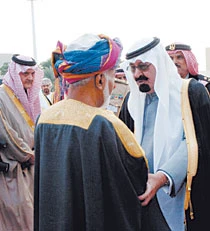
King Abdullah arrived in Muscat on Saturday at the head of a high-level delegation, his first visit to Oman after ascending to the throne in August 2005. Officials in both countries said the three-day royal visit would strengthen bilateral relations. As a manifestation of their close relations, King Abdullah conferred on Sultan Qaboos the King Abdul Aziz Medallion, the Kingdom’s top honor. Qaboos reciprocated by awarding the king the Medal of Oman of the first order.