
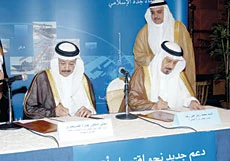
JEDDAH, 26 December 2006 — An investment of SR1.662 billion ($443 million) has been envisaged to increase the capacity of the Jeddah Islamic Port (JIP) by 45 percent. This follows the signing of a license agreement by Minister of Transport and Chairman of Sea Port Authority (SEAPA) Jabara Al-Seraisry with Saudi Trade and Export Development Company (Tusdeer) at a ceremony here yesterday. Tusdeer will develop and operate a third container terminal at JIP on a build-operate-transfer (BOT) basis.
“The project reflects a major move in the Kingdom’s ongoing development to meet its growing challenges,” the minister said. “In the past few years, the Kingdom’s seaports have witnessed big efforts to develop and modernize their working capability alongside the increased number of container ships,” he said, adding that in the last three years JIP’s rank has jumped to 27 among 100 international ports. “JIP has jumped 29 ranks in the past four years,” he said. Tusdeer Chairman Mohammed A. Zainal Alireza said the new terminal would be built on a reclaimed land along the re-export zone at JIP. It is expected to handle up to two million 20-foot-equivalent unit (teu) containers annually and will be equipped to accommodate the biggest and latest container vessels under design. The proposed terminal will include a handling and storage area covering about 400,000 square meters. “The estimated SR1.662 billion ($443 million) project will take about three years to become operational, with dredging work expected to start by mid-2007,” he said.
“The project will expand JIP capacity by 45 percent and help maintain Jeddah’s lead as the hub port of the region,” Alireza said, and referred to the minister’s commitment to the project. “The objectives of the new project are in conformity with the vision of Custodian of the Two Holy Mosques King Abdullah to encourage the private sector to play an effective role in establishing and developing the infrastructure of the Kingdom,” Alireza added.
The new container terminal is also expected to contribute to the planned Land Bridge with the completion of the Saudi Railways Project, creating a fast and efficient land-based link from the Red Sea to the Gulf. Additionally, the project will help boost the business activity of consignment and re-export across the Kingdom, generating job opportunities for Saudis, as well as increasing the competitive capability of the marine transport and support system of the Kingdom.
SISCO Chairman Saleh Hefni said that initial designs for the new terminal were created taking into consideration latest, next generation technologies in the marine transport field. The terminal will have Super-Post Panamax quay cranes, berth depths of over 18 meters and an independent 165.5 meters deep navigation channel — making it ready to efficiently service the largest and most advanced class of next generation container ships that can carry loads in excess of 14,000 teus.
“The terminal will be supported by advanced IT systems to facilitate a free flow of updated information and provide near paperless transactions between port personnel, shipping lines, marine services and freight forwarders,” Hefni said.
Tusdeer, a subsidiary of SISCO that was established to develop and operate the first re-export zone at JIP, has brought together a world-class team to develop the new terminal.
It has joint-ventured with Seaport Terminal of Malaysia, which built and developed the Port of Tanjung Pelepas (PTP).
The Malaysian firm, with a 20 percent stake in the project, was brought in for its expertise and success in operating the fastest growing port in Asia. UK’s Drewry Shipping was commissioned to conduct a market study and demand projection analysis for container traffic at the JIP.
Edaw/Aecom, a world leader in international engineering and master planning entity, was selected to develop a 30-year master plan for the terminal. Tusdeer took a step further and appointed Maunsell from Australia to conduct a detailed rail and road network analysis for solutions to ease traffic around the port area and effectively connect to the upcoming Saudi Land Bridge Project, a move that is aimed to benefit the whole JIP.
The project is proceeding at full steam. All marine surveys and soil testing works have been completed and four major international consultants have submitted bids for the design and engineering contract.
The successful bidder, to be decided by the beginning of next year, will conduct the terminal’s design and engineering, and oversee the project execution.
Past few years, the seaports in the Kingdom have witnessed big efforts to develop and modernize its working capability to go wide by side with the increase in arrival of container ships. In last three years.
JIP ranks 27th in 2005 among 100 international seaports. It has jumped 29 ranks in less than four years.