AL-MASHAER CIVIL DEFENSE BASE, Mina, 29 December 2006 — It seems to be just another one of the many emergency numbers. But when a person dials 998, he or she is usually in the midst of a crisis and they need a fast, professional response. Many people think that Civil Defense personnel only handle firefighting. The truth is that in every sort of disaster, from flood to building collapse, is Civil Defense staff who are called to save the day.
Arab News toured the Civil Defense operations at Al-Mashaer Base yesterday. Located on the outskirts of the tent city of Mina, this is the command headquarters for Civil Defense’s Haj operations. The headquarters is filled with high-tech electronic equipment and hundreds of highly qualified staff. Doctors, engineers, pilots, network technicians — the level of skilled personnel assembled at Al-Mashaer is impressive. The base has its own hospital, helicopter landing and maintenance facility, control room, communications and network monitoring system, fleets of vehicles — just about anything that is needed to respond instantly to any emergency is available.
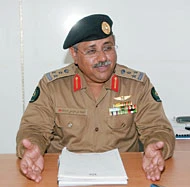
The commander of the base, Brig. Gen. Ahmed ibn Mousa Morssal, stated that many of the senior people working on the team supporting the pilgrims have been with the Civil Defense for two decades or longer. He explained that only the most experienced personnel are assigned to lead the teams providing assistance to the pilgrims as the Haj is no place for amateurs. In a crisis, decisive, rapid action is needed to avert tragedy and that is when having the most experienced team can be the difference between life and death.
Morssal remarked that every year Civil Defense brings new technologies and techniques into its operations to keep the Haj rituals moving along safely and smoothly. Now, helicopters are constantly in the air, checking activity at the holy sites block by block. The helicopters are backed up by stationary cameras mounted throughout Makkah, Mina, Muzdalifah, Arafat and along the routes between the sites. Civil Defense personnel on the ground also communicate directly through secure channels giving regular updates on activities in their area of assignment. Morssal advised that the staff have been instructed to always err on the side of caution. If a hazard is suspected it should be reported so the situation can be investigated and if necessary rectified immediately rather than waiting until a catastrophe is in progress.
This is especially important when it comes to bottlenecks in the movement of pilgrims. Helicopters are frequently used in these situations to direct Civil Defense personnel on the ground so the pilgrims can be diverted before a stampede begins. If a crowd has formed and pilgrims are hurt, the helicopters are even fitted with special equipment to transport the injured to nearby medical facilities, rather than waiting for a path to be cleared for ground ambulances to reach the site.
Brig. Gen. Abdullah Al-Ofi, who is one of the top men at the base, said that in a crisis, observers sometimes feel that emergency rescue crews are not moving fast enough. In truth, in any crisis affecting pilgrims, Civil Defense personnel mobilize immediately and are on the scene in minutes. However, they always must be careful not to cause further harm by charging into a situation without an awareness of the risks facing them. As an example, Al-Ofi spoke about the Civil Defense response to the fire last week at the Dar Al-Gaza apartments in the Juffali Building located about 200 meters from the Grand Mosque.
“People had rushed up to the roof of the building to escape the fire,” Al-Ofi said. “They wanted our helicopters to land and airlift them to safety instantly. Of course, we planned to do that all along, but first we had to instruct the people to move to one side of the roof. Then the pilot had to note the direction of the wind so he could keep the helicopter out of the smoke. The helicopter cannot stay airborne if its engines are engulfed by smoke. Only after the pilot was sure that he could move in safely, could he approach the rooftop.”
It should be noted that it was Civil Defense that provided accommodation for the pilgrims taken from the burnt-out section of the building so that they could complete their Haj rituals.
It is not only in the immediate Haj period that the Civil Defense personnel perform a service to the Ummah and the nation. Each year they film the holy rituals and write reports concerning problems faced by pilgrims during Haj. All the information they collect about Haj is provided to the Haj Research Center. The academics at the research center examine all the data and propose solutions to the problems.
When the Al-Mashaer Base opens for the new Haj season in the month of Rajab, the recommendations from the Haj Research Center are put into action. Some recommendations from the center result in extensive, expensive infrastructure improvements. Next year at the Jamrat Bridge, there will be two helipads where the Civil Defense helicopters can land in case of emergency on the bridge itself. This will enable injured pilgrims to be airlifted off the bridge when ground ambulances are having difficulty getting through the crowds.
The Civil Defense officials mentioned the complex operations to provide meals for the pilgrims. Years ago, based on recommendations from the Civil Defense, authorities implemented a total ban against using liquefied gas for cooking in holy sites. This means that meals for pilgrims are trucked in at greater expense from outside the area rather than risk a fire at the holy sites. Civil Defense teams conduct inspections to ensure everyone abides by this restriction. The commanders stated that this policy coupled with the use of fireproof tents had brought great protection to the pilgrims.
“In everything we do, we have the safety of the pilgrims in mind,” said Abdullah M. Maghrabi, commander of the Civil Defense Airlines. “We have strict instructions to treat the guests of Allah with the greatest respect. If the securitymen are attempting to move people from an area due to overcrowding, they do so with politeness. All of us are here to guide the pilgrims in the best way possible. We cannot do everything and I am the first one to ask that the Haj organizations back in the pilgrims’ home countries educate the pilgrims on what will be required in the performance of the holy rituals.”
The Civil Defense team was very enthusiastic to answer all media questions and to demonstrate various systems and equipment. The transparency of the operation is inspired by the actions of the head of Civil Defense in Makkah Lt. Gen. Saad ibn Abdullah Al-Tuwaijeri. Well known to lead from the front in any crisis, Al-Tuwaijeri is known to be “hands on” in resolving difficulties facing the pilgrims and is considered to be one of the most approachable government officials at the Haj. In part it is his strong, able leadership that attracts the best Civil Defense personnel to request Haj duty year after year.
Morssal pointed out that many of the Civil Defense staff, despite being at the holy sites for 20 years, had never been able to perform Haj themselves as they were always assigned to protect and serve the pilgrims. “At this time of year the Civil Defense personnel are always on duty,” said Al-Ofi. “We consider this duty to be more than Haj.”
This Civil Defense protects the pilgrims outside Makkah and Mina as well. For pilgrims who come to Saudi Arabia by sea, it is the Civil Defense staff that monitor ship movements as soon as the pilgrim vessels are in international waters. They are constantly on the alert for any SOS from the ships and in difficult weather conditions they move rescue vessels into position to respond quickly in case a vessel gets caught up in wind or a storm.
“When there’s a tragedy we are the first ones to bring relief,” said Al-Ofi. “I remember when I was new to the Civil Defense two decades ago and there was a terrible flood in Al-Ola. It was so bad that schools and buildings were washed away. We rescued so many people from the mud and water. It was hard work but it felt so good to help people. That good feeling is what encourages me even now to want to provide the best services to the pilgrims I am serving.”
When there’s a tragedy at the pilgrimage, negative comments will be directed at the Kingdom. But no one cares to comment on the billions of dollars that have been spent in infrastructure and services over the years to improve conditions at the holy sites. Over two million pilgrims are anticipated at the holy sites again this year and the Civil Defense personnel will do their level best to try and ensure that every one of them makes it home safely to their loved ones again. However, the pilgrims themselves must do their part for the safe, successful completion of this year’s Haj.