
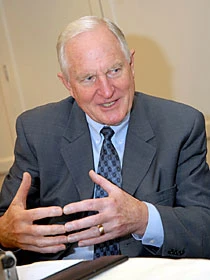
RIYADH — In November 2005 when Chairman of the Board of Intel Corporation, Dr. Craig Barrett, spent a day in Saudi Arabia, it was more of a meet-and-greet visit, and a chance for Intel to raise its profile in the Kingdom. In December 2006, when Dr. Barrett came back to Riyadh again, Intel’s chairman knew the Saudi market better and there was definitely an underlying sense of frustration in his tone when he spoke about the progress the Kingdom was making in regards to transforming itself into a knowledge-based economy.
In his speech, “Intelligent Cities Empowered by IT Infrastructure” at the First Economic Cities Forum sponsored by the Saudi Arabian General Investment Authority (SAGIA) and in a Q&A after the speech, Dr. Barrett emphasized that in the area of ICT the Kingdom needs to do more, faster. He stated that with the Kingdom planning to build four economic cities of the 21st century, almost from scratch, there was a need to incorporate the latest, most competitive ICT technology available. The Kingdom should not be following the example of others but should be leading the world in incorporating IT infrastructure into these economic cities — especially if the economic cities are to be a magnet for foreign direct investment.
In an exclusive interview with Arab News after the event, Dr. Barrett explained that while he commends the government on the direction it is taking in regards to the economic cities, his advice is to concentrate on bringing “world class” technologies into those cities, not simply creating an infrastructure based on competitive technology.
“Where you get to quite often depends on where you set your sights. If you just look around you today and say, ‘What does it take to be competitive, to be one of the pack?’ Then that’s probably as good as you’re going to get,” Dr. Barrett advised. “But if you say, ‘I want to do something unique. I have the opportunity to do something unique, so I really should take advantage of that opportunity and you set your sights on surpassing the rest, then you’ll have that opportunity. I don’t think if you’re an athlete, an athlete has ever been terribly successful just by saying, ‘I want to be competitive.’ Athletes are successful when they say, ‘I want to be the best.’ When you want to be the best, you measure yourself on the absolute world standards. You set your metrics, your indicators and your training plan consistent with that.”
Dr. Barrett is disappointed with the level of broadband connectivity in the Kingdom and he remarked that inadequate broadband resources are holding the Kingdom back in areas from business to education.
“Connectivity is behind the power curve. The amount of broadband in Saudi Arabia is very low,” commented Dr. Barrett. “The country should be measuring itself on international standards. Not on local standards or on the standards in adjacent countries. Both the penetration rate of broadband and the relative cost of broadband, those are two indicators that need a lot of attention locally. In general, what drives the availability of communications infrastructure is in fact the combination of competition and technology. If you look at Japan as a good example, they have fantastic broadband and very low prices. In Saudi Arabia, CITC is talking about reducing prices by half. It’s not enough. You have to talk about something that is a factor of a hundred cheaper than that.”
Getting directly to the point, Dr. Barrett believes that the lack of competition in the communications sector is the reason for the Kingdom’s poor connectivity.
“The reason Saudi Arabia lacks connectivity is because of the lack of competition. The technology now is capable of bridging the physical distances and the lack of wired infrastructure. There is no excuse anymore for the lack of connectivity,” Dr. Barrett said. “The rapid introduction of technology and the aggressive pricing of technology follows right behind competition usually. You need not only competition between types of technology, whether it’s satellite, fiber, wireless — you pick it. But then it’s also helpful to have competition within the technology segments as well. Basically Saudi Arabia has a single fixed line carrier. There’s not much competition there. You have a couple of mobile carriers. So that technology is growing faster and becoming more reasonably priced.”
For Dr. Barrett this lack of emphasis on fast forwarding the development of telecom resources is something of a mystery, especially when he noted all the construction sites around Riyadh.
“There’s a huge amount of physical infrastructure being built. Not to build out the information infrastructure at the same time would be almost criminal,” observed Dr. Barrett. “There are technology road maps available on the telecom side and there are implementation road maps available for people to follow. The growth of the mobile industry here is not unique to Saudi Arabia. Just open up your eyes and look around the world and there are instances where other countries have gone through the same build out. You know that the fixed line stuff is not going to be built out, it’s all going to be mobile. You know that mobile is going to go to higher bandwidth so you know what those technologies are. There are no secrets associated with any of those things. And don’t sit and wait for the economic cities to be created. When I look at the CITC indicators, I would say that they are interesting but you’re comparing yourself to yesterday. Compare yourself to tomorrow. It’s not just the intelligent cities that have to have those information infrastructure features, the country has to have those features.”
What it really all comes down to is decision-makers in Saudi Arabia stepping up to the line and putting in place policies and regulations that support the rapid, transparent growth of high quality, low cost, public ICT resources.
“You have to determine what your top priority is. I think the best thing that any government can do is give its population the tools to be successful. If they do that then in fact the government will reap the benefits. You won’t be a successful economy by placing heavy taxes, fees or other burdens on the commodities you need to be successful,” said Dr. Barrett.
One measure of a successful economy is a low unemployment rate. The Kingdom is struggling to create jobs for its young people, so there is an urgent requirement to find new commercial segments where innovative, intelligent individuals can thrive. In markets where there is good broadband penetration, businesses that develop local information content for consumers and businesses are doing well and creating thousands of new jobs.
“When people in Saudi Arabia see content from London or New York or downtown Johannesburg, they say, ‘So what?’ In Saudi Arabia that content needs to be in Arabic and needs to be relevant. And who better than local people to create that local content in Saudi Arabia?” Dr. Barrett remarked. “So it’s a local industry driver, a local wealth creator, a local job creator to do that. But to encourage local content creation you need to put broadband in.”
Numerous high level executives come to Saudi Arabia every year and attempt to give the government and business community advice on what technologies should be implemented and what the road ahead for the Kingdom should be. So why should we listen to what Dr. Barrett has to say? Well, actually because unlike most executives of international ICT firms, Dr. Barrett spends a considerable amount of time annually in the developing world. He travels to about 30 countries per year, so his advice is based on more than just white papers and industry studies. Dr. Barrett is also the chair of the United Nations Global Alliance for Information and Communication Technologies and Development.
“I tend to go to the market places that I think are exciting and have big potential, so I spend a lot of time in the emerging markets of Latin America, China, India, the Middle East,” Dr. Barrett said. “This happens to be my second time here in Saudi Arabia, but it won’t be the last time.”
On a recent trip, Dr. Barrett got a reminder of what it’s like to attempt to function in the digital age when all that’s available is a dial-up connection to the World Wide Web. When asked to describe that experience, Dr. Barrett expressed himself emphatically:
“It was horrible. Come on be serious! I was on vacation in Bhutan and then in north India. It’s the kind of place where you check into a hotel and there is very limited connectivity and the computer’s screen paints line by line. That doesn’t solve a problem. That just creates frustration. You know what that’s like and you know what it’s like to have a megabit type connection where you just hit ‘enter’ and the screen is there. It’s night and day.”
Dr. Barrett admitted that having nothing available but dial-up had forced him to reconsider mundane online tasks such as downloading his e-mail.
“With a broadband connection I don’t even think about the size of e-mail attachments. But this certainly changes when you go back to dial up,” said Dr. Barrett. “That’s when you find the little rule box and you check ‘Do not download anything over 50k.’ Then you discover that somebody has sent you a 6MB or 8MB or 10MB file and you say, ‘that’s not going to work.’”
For Dr. Barrett, being stuck in a dial-up world was an inconvenience. For 90 percent of people in Saudi Arabia, dial-up is either all that’s available or all they can afford, so they have no choice but to make it work somehow. That’s why all the announcements of economic cities and all the seminars on a Saudi knowledge economy are actually leading nowhere if the Communication and Information Technology Commission (CITC) doesn’t rapidly move to enable a connectivity upgrade for the Kingdom.
(Comments to: [email protected].)