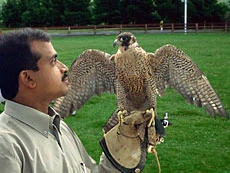
JEDDAH, 10 January 2007 — The falcon remains an integral part of the Arab lifestyle and tradition since falconry has long been an important sporting activity. But for Dr. Zubair Medammal, the first Asian scientist to win a doctoral degree in falcon studies, this royal bird is more than a fascination.
Zubair won his doctoral degree from the University of Calicut after conducting six years of research on the bird. He is the first non-Arab to get a membership of the Emirates Falconers Club and the first to prepare a sonogram collecting 15 different sounds of falcons.
He has also received many laurels including the Young Scientists’ Award from the chief minister of Kerala. Last year, he presented a paper at an international scientific conference on birds. He has received an invitation to present another paper at Bird Census 2007 to be held in Italy in April this year.
Qatar University has translated his thesis into Arabic in order to use it as a reference for degree students. He intends to publish the book in both English and Arabic and is looking for a publisher. He is a member of the Worldwide Fund for Nature and Natural Resources and Bombay Natural History Society and World Malayalee Council.
Arabs account for one-third of falconers in the world and they import falcons from European countries, especially Germany, which has a suitable climate. Germany is a major breeding center for falcons and Zubair has received special training in artificial falcon breeding from the German city of Stuttgart.
Spelling out the special features of falcons, he says a falcon lays a maximum of four eggs in a year. Half of the eggs are destroyed, he said, emphasizing the need for artificial breeding. The birds usually live on top of mountains, towers and other secure places. “When a falcon goes on a hunting flight, its speed reaches about 350 km per hour. It cuts the cervical vertebra to kill the prey and eat its liver. Houbara bustard is its favorite food.”
There are 52 species among falcons and Zubair’s studies focused on five of them. It is the national bird of the UAE, which has at least 10 falcon hospitals to provide necessary treatment to the king of birds. It is believed that Arabs have hunted with falcons for the past 2,000 years.
Zubair, who is on a visit to the Kingdom for Haj, warned that falcons would soon become an endangered bird as a result of food shortage, accidents and effect of pesticides. “About 35 percent of falcons die after eating prey that has been exposed to pesticides,” he told Arab News.
He called upon governments and wildlife conservation agencies to adopt effective measures to protect this lordly bird from extinction. He also urged tougher action to stop the smuggling of falcons, which has become common as its price ranges between SR10,000 and SR1.2 million.
Gyr, which is well-known for its majestic appearance, is the most expensive of falcons. “It is the only bird that requires a passport to travel from one country to another,” he said referring to the measures taken by some Gulf countries to protect the bird. “This also reflects the importance given by GCC states to falcons,” he added.
A falcon passport, which includes important information about the bird such as its species, nationality, owner’s name and arrival date, is valid for three years, Zubair said. The UAE launched the system in 2002 to ease frequent movement across borders for purposes of falconry.
Zubair’s fascination with falcons began in 1993 when he was in the UAE on a job hunt after completing his postgraduate studies in zoology. The board of Sheikh Zayed Falcon Research Hospital in Khazna attracted his attention. He approached the hospital for a job but its German manager rejected his application. “I took it as a challenge and decided to do an in-depth study of falcons,” he added.