RIYADH, 21 January 2007 — Labor Minister Ghazi Al-Gosaibi said yesterday that his ministry intends to implement a new policy where companies would have to prove that they are financially viable before recruiting workers from abroad. “We have an initiative we intend to implement that links the import by any company of foreign laborers to its capital and its capability of paying their salaries,” Al-Gosaibi said.
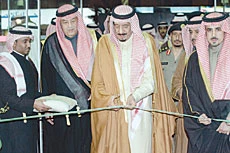
Speaking to Arab News last night at the newly inaugurated headquarters of the Labor Ministry, which was inaugurated by Riyadh Gov. Prince Salman yesterday evening, the minister said that the guarantee of payment of salaries to foreign workers was a top priority for the ministry.
On his part, Prince Salman warned yesterday against any superfluous recruitment of foreign guest workers.
“The import of foreign labor should not exceed the necessary requirement,” he told reporters. “Young Saudi men and women should be given training opportunities to enter the job market.”
Minister Al-Gosaibi didn’t provide further details of this new initiative to crack down on companies that delay or refuse to pay the salaries of their guest workers, but underscored his ministry’s efforts to receive complaints from employees through 37 labor offices across the country. “Companies involved in abuse and mistreatment are immediately punished by denying them the right to import laborers for a number of years, or even forever,” he said.
The minister also addressed the issue of Saudization, the effort to replace foreign guest workers with Saudi ones. The ministry has already barred companies with no Saudi workers from further foreign recruitment, and it made public the names of these companies. Al-Gosaibi said yesterday that the ministry is raising the bar to making the blacklist to five percent, meaning companies with five percent or less of Saudi workers will be revealed publicly and they will be barred from foreign recruitment.
“We will label them and publish their names and give them an opportunity of up to a couple of months to rectify their situation,” he said.
He said that his ministry was not in dispute with businessmen, but that some executives do not adhere to the Saudization quota and were behaving unpatriotically by looking abroad for workers.
“If they could they would import all of their laborers from abroad,” he said, pointing out that the economic giant the United States only allows the import of 25,000 laborers per year. “What more do they want? That we bring everyone from China or India here? That is not possible,” he said.
The minister said that his ministry would not interfere with countries that plan on curbing their export of housemaids to the Kingdom, saying that citizens are given a chance to choose according to their budget. The minister was referring to more stringent rules implemented in the Philippines for recruiting housemaids for the Kingdom.
Through its labor offices in the country, the ministry has successfully employed 148,481 unemployed Saudis in the private sector since its employment campaign started in 2005.
Asked by Arab News on the ministry’s measures to increase the participation of Saudi women in the job market as per the Council of Ministers’ resolution two years ago, the minister said his ministry was currently collaborating with other ministries to open branches for women.
“We have set a long-term plan with a number of ministries, such as the Ministry of Finance and the Ministry of Economy and Planning, to open branches for women,” he said. “We have also given directives to other ministries to open branches for women when needed and opened three women’s branches in the Labor Ministry.”
He said that there has been progress in the private sector by a number of factories opening branches for women workers.
“We are following up with the private sector the opening of women’s sectors,” he said. “We are also working with the Ministry of Social Affairs to endorse the program for working families.”