
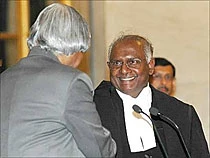
JUBAIL, 27 January 2007 — It would be very unfair to Justice K.G. Balakrishnan to describe his elevation to the post of the chief justice of India as a mere Dalit achievement. Such a comment fails to take note of the eminence Justice Balakrishnan has rightly enjoyed among India’s judicial fraternity for the past two decades.
It was the respect he commanded as a practicing lawyer and later as a lower court judge, which culminated in his appointment as a high court judge in 1985.
From there, he moved to the Gujarat High Court as the chief justice. And later in 2000 while serving as Tamil Nadu chief justice, he was appointed a judge to the Supreme Court of India. Justice Bhaskaran who selected him for the High Court did so because of Justice Balakrishnan’s impressive performance as a lower court judge at Kaserkode and Ernakulam and later as a high court lawyer.
The reservation of seats in colleges or government jobs has not benefited Justice Balakrishnan at any point in his education or his profession. His parents were better educated than most in comparison to the average pre-independence level of education in Kerala.
His father was a matriculate and mother a high-school dropout. This might have worked as a launching pad for their children.
In many of his interviews, Justice Balakrishnan has cited his parents’ particular interest in their children’s education as the major factor contributing to his eventual success.
In short it would be a gross misrepresentation to ascribe his success to constitutional reservation for Dalits or anything related to that.
In the Dalit context, if his elevation proves anything it is the weakening of the chains of caste-based discrimination and the Dalit community’s growing competence in challenging the centuries-old marginalization of their community.
Justice Balakrishnan is a matured man in every respect. During his long career, he has steadfastly resisted temptations and managed successfully to maintain a cool and calm exterior.
During one interview, he noted, “It is not my habit to be overly anxious about anything. That is a trait I have nurtured since childhood. I always try to complete the task in hand to the best of my ability.”
Justice Balakrishnan lamented the prevailing tendency to fault the judiciary whenever its rulings go against political parties or public opinion.
He pointed out that even judges, when laws demand it, may be compelled occasionally to rule against their own personal opinions. According to him, legal verdicts have everything to do with the existing constitutional provisions and very little to do with the personal opinion of judges.
Though the judicial wisdom behind Justice Balakrishnan’s opinions is impeccable, I don’t think that even he can deny the fact that the character of the judge exercises an influence on the interpretation of constitutional provisions. In a country, where outright discrimination has been practiced for centuries against Dalits, backward classes and minorities (who constitute more than two-thirds of the population), such biases carry critical importance.
This is especially so when courts are hearing petitions challenging legislation related to reservations for Dalits, backward classes and minorities. It is also the case with litigation involving workers’ grievances and trade union rights as well.
It is, however, relevant to note here that it is the primary responsibility of political parties to initiate corrective legislative action rather than marches, general strikes and shutdowns against the judiciary when its rulings go against majority opinion in a democratic society.
Hence the current practice of political parties to use pressure tactics against courts is certainly undesirable.
Justice Balakrishnan is tolerant of criticism of the judiciary. On many occasions he conceded that there are complaints about corruption but points out that the high courts have never condoned it and, in proven cases, have initiated punitive action, including forced resignation or removal from service.
He also affirmed categorically that there were no problems between the judiciary and legislature, which emphasizes his intention to avoid confrontation between the two important state organs.
When asked about caste-based discrimination in the judiciary, he said that he had never experienced it. Nonetheless Doordarshan’s refusal to telecast live the swearing-in ceremony and BJP’s refusal to attend the function speaks volumes about the continuing grip of Hindu orthodoxy and caste in Indian public life.
Keralites still have much to celebrate in Justice Balakrishnan’s rise to the Indian judiciary’s top most position. Though many, such as Justice V.R. Krishna Iyer and Justice K.T. Thomas, served on the Supreme Court bench, Justice Balakrishnan is the first Malayalee to become the chief justice of India. It is certainly a proud moment for Kerala. That India’s first president from the Dalit community, K.R. Narayanan, was from Kerala is an indicator of the narrowing gap between the state’s Dalits and its ruling class.
As for bureaucratic excellence, Keralites have a long list that includes India’s National Security Adviser M.K. Narayanan, Counter Intelligence chief Hormis Tharakan, head of Space Research Organization G. Madhavan Nair, Foreign Secretary Siva Sankara Menon, Prime Minister’s Principal Secretary T.K.A. Nair, Lok Sabha Secretary General Achari, Air India chairman Thulasi Das and Vijay Nambiar who is the new UN chief of staff.
India’s national secretariat is again becoming a Malayalaee fiefdom as it was during the era of Nehru.
It is also a pleasant reminder to note here that V.K. Krishna Menon was the defense minister in Nehru’s Cabinet and another Keralite A.K. Antony is the current defense minister in Manmohan Singh’s government. Does this herald a Malayalee spring in New Delhi’s power corridors?