DAVOS, Switzerland, 28 January 2007 — “The Shifting Power Equation” is the theme of this year’s World Economic Forum, and one of the emerging giants best exemplifying that shift is India. Therefore, the level of interest at a session titled, “India and the Global Services Economy,” was of particular interest to forum delegates.
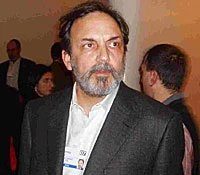
That interest extended beyond the panelists on the dais into the audience when NDTV chief Prannoy Roy spoke about the evolution of Indian democracy and the need for politicians to become more responsive to voters.
“The nature of Indian democracy is changing,” he said in his signature soft but crystal clear voice. “In the first 40 years after independence, voters were largely passive and tended to return the party in power to office,” he said. “However, during the last 15 years, voters are becoming far more active. There is an 80 percent chance,” he noted, “that incumbents will be voted out of office. Earlier there was an 80 percent chance of getting back into office. As a result, politicians have to campaign permanently rather than show up every few years or so in their home districts.”
That means, Roy concluded, that politicians must be more responsive. The panelists — Commerce and Industry Minister Kamal Nath, Satyam Computer Services Chairman B. Ramalinga Raju; TPG Growth Partner Vivek Paul, and Global Chief Executive Officer William G. Parrett — agreed with Roy, adding that this would ensure that politicians have an incentive to intervene to remedy many of the problems discussed by the panel.
The session’s moderator started by describing the problems facing India’s global services sector. Although the scope for growth is promising, he observed, there are critical shortcomings facing the sector, including the shortage of skilled manpower and energy as well as the state of the public infrastructure.
Kamal Nath said the world is in the midst of a “paradigm shift,” with growth concentrated in cross-border movements of tasks which are being delegated to new sources of labor, often at bargain prices. However, he observed, “This is about entrepreneurship and not merely technology.” India is now, he argued, “the largest producer of entrepreneurs in the world” — a development that was driven by the private sector and remains unobserved by the government. “Our future is bound to them, and the government should leave them alone as it has done until now.”
Vivek Paul agreed with Nath. Not only is India succeeding in achieving unprecedented rates of skilled job growth — in the tens of thousands per month — but it is developing methods to control the management of this process in terms of quantitative benchmarks, techniques of integration, and the like.
“India will become a lynchpin of globalization,” Paul said. “Already, India is powering the world’s intellect. Soon the world will not be able to afford it if India strays off course.”
As a result, people everywhere are discovering that they need to compete in entirely new ways. Unfortunately, he noted, this is creating new social pressures, in particular on an international scale with the fear of job losses. “People should not assume they are entitled to keep their jobs for life,” Paul suggested.
As a user of global services, Parrett said that his firm employs 9,000 service providers in India, two-thirds working exclusively for overseas clients. In his experience, India has a proven track record for highly educated workers with excellent language capabilities, entrepreneurial talent and political stability.
On the negative side, he observed that its infrastructure requires significant upgrading. By contrast, this is a priority of the Chinese government and seen by Beijing as a competitive advantage. While wages may rise as the supply of skilled global service workers outstrips demand, he said, “What we need is talent, so cost is less of a factor for us. We will keep hiring there.”
B. Ramalinga Raju observed that globalization is creating new ways of generating wealth. “We should not look at this as a zero-sum game,” he argued. “We are in a new era and everyone will benefit, not only in employment, but also in efficiency gains.” According to Raju, any attempt to fight this trend will result in lost opportunities.
Regarding India, he was concerned that there could soon be a shortage of skilled labor: the government needs to increase the capacity to educate engineers beyond the current graduation rate of 300,000 per year. “There is a demand bubble coming,” he said, “and we must build our capacity.”
The quote of the quote on India came from Sunil Bharti Mittal, chairman and group managing director of Bharti Enterprises. At a key session, he noted that the legal tender of the future will not be dollars, euros or pounds sterling, but human assets. “India has 630 million people who are working age,” Mittal said. “This will be 830 million in 10 years. This is not an Indian work force but a global work force, which is willing, able and, to a certain extent, restless.”