
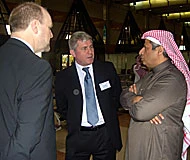
DAMMAM, 29 January 2007 — Last week, before hosting a luncheon for Terry Evans, head of the British Trade Office, Alkhobar and members of the UK’s first Railway Sector Mission to Saudi Arabia, Khalid Alyahya, president of the Saudi Railways Organization sat down with Arab News to discuss the Kingdom’s rapidly expanding railway sector. Since the earliest days of the 20th century, railways have played an important role on the Arabian peninsula. Now, as modern technology makes railways more affordable to build and operate, the Kingdom plans to rely even more on rail transport. In fact, although it is not well known, in the Eastern Province, both businesses and the public have long depended on the railways.
“Between Riyadh and the Eastern Province, SRO operates two short lines. One is for passengers and one is for freight, but they are very heavily used lines in terms of volume,” the SRO president said. “Rail is the first mode of public transport between the Eastern Province and Riyadh. More people travel by train than by air or buses. As far as freight is concerned SRO moved about 300,000 containers from the port of Dammam to Riyadh. We have an 85 percent market share in this segment, the container business between the port of Dammam and Riyadh and we have been increasing the volume of freight that we are transporting between the two regions.”
When asked if the Riyadh-Dammam rail link is profitable, Alyahya didn’t hesitate to explain the financial dynamics of the railway.
“For freight it has become profitable, if you take it as a profit center,” he replied. “For passengers, given the ticket prices we are offering, it is not profitable and it is not likely to be profitable in the future. The situation in regards to railways and passenger transport is not unique to Saudi Arabia. In many countries, whether developed countries or developing countries, we see this kind of support from the government to subsidize this essential service for the people.”
The SRO president then moved on to discuss the future of railways in Saudi Arabia. He advised that there are three projects that will expand the existing railway network by more than 3,000 kilometers. One of these is the Landbridge Project that will connect the two main seaports of Saudi Arabia — Dammam and Jeddah — through Riyadh. In Riyadh there is a dry port facility that receives bonded containers coming to the Riyadh market.
“We are also planning a state of the art high speed rail system to connect Makkah and Madinah,” Alyahya said. “This is about 450 kilometers of rail line. It will achieve a journey time of about two and a half hours between Makkah and Madinah and two hours between Jeddah and Madinah. We are now qualifying investment consortia who will build this project. The closing date for receiving expressions of interest for the Makkah-Madinah Rail Link (MMRL) is the end of February. Then there is the third project which serves the mineral sector. The North-South Mineral Rail Project is being implemented as a public works project with funding from the government. The earthwork has started on that project and we expect that the construction contract will be awarded in the coming weeks.”
He added, “I need to mention here that the Landbridge and the MMRL are to be implemented as private sector projects, meaning that the concessions will be awarded to the private sector to build and operate these projects for a specific period. It has been announced that the concession period for the Landbridge will be 50 years and a decision will be taken shortly in regards to the concession period for MMRL.”
Recently there has been quite a bit of interest in the oldest railroad in Saudi Arabia, the Hijaz Railway. Alyahya commended the restoration work being done by the Supreme Commission for Tourism (SCT) but said it will be sometime before there is a revival of the railroad in terms of transport.
“Quite a bit of work has been done by SCT to preserve some of the structures of historical importance in the Hijaz Railway,” Alyahya commented. “As far as reviving the railway itself, that could be a possibility in the future, but we always maintain that for Saudi Arabia to connect its railways internationally, it first has to develop its internal network. Once we make it a strong network that carries substantial volumes of traffic, then the time will be appropriate to start talking about connections to the Gulf and to our neighbors to the north.”
There has also been much talk about bringing railways into the cities. These light rail projects would be for public transport and Alyahya pointed out that while he thinks they have potential, SRO won’t be overseeing those projects.
“Light rail and mass transit systems for the cities are the responsibility of the municipalities not the SRO,” he advised. “However, I am aware that investigations are underway for putting a light rail system in Riyadh and to a certain degree another system for Jeddah. I think that these projects could be very useful on certain routes in both cities. Our cities have been developed as low density cities and light rail and metro systems are most cost effective in high density cities. But nonetheless, I believe that there are certain main arteries in these cities that can support such systems. Additionally, modern monorail systems are much more reasonable in price to build and operate than older subway systems. That increases the potential that a rational case can be made for the implementation of inner-city light rail.”
Turning his attention to SRO projects, Alyahya stated that safety has become an increasing focus of railway operations in the Kingdom. With new projects beginning and more track coming under the organization’s purview, SRO wants to ensure that everything possible is done to operate all Saudi railways safely.
“We have started a project to eliminate all the level crossings — these are places where roads cross the railway lines — in the existing rail network. All the new rail lines are being designed from the beginning with no level crossings so that goes a long way towards safe operations of the railways,” said the SRO president. “We are now introducing a state of the art signaling system which will also contribute to the efficiency and safe operation of the railway. And the fencing of all railway lines is being implemented now. More than 80 percent of the lines are already fenced. So we are making definite progress in regards to safety. The new projects are huge projects that will employ many more people, but I can assure you that the expert, experienced employees of SRO will serve as the nucleus of a strong, safety conscious national transport system.”