
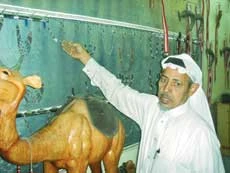
HALF a century ago, Jeddah’s first airport echoed with the bustle of traffic and travelers, many bringing knowledge and labor to the rising Kingdom. During the season of Haj, the sea of pilgrims ebbed and flowed turning this now quiet and slightly seed section of eastern Jeddah into a riot of color and business.
Today, in a row of shops set back from the continuous current of traffic that roars past to business elsewhere stands a row of unprepossessing small shops on Jeddah’s old Airport street. Known to ‘those who know,’ they are famous for their collections of antique and un-regarded items that form part of the history of Saudi Arabia.
One of them belongs to Ali Al-Zahrani.
He rises to his feet and welcomes you with a genuine smile and warm greetings.
“During my teenage years I had a strong inclination toward works of art that belonged to ancient times,” he said. His light colored eyes and the deeply etched lines on his face sketch the story of his life.
While still young, he started collecting oriental antiques, classic carpets and Bedouin decorations that had a high value due to their considerable age.
If you tarry a while, you will see Ali Al-Zahrani as he interacts enthusiastically with his customers while hearing the news coming from the small television in the background. The rich aroma of fresh Arabic coffee he offers to his friends mixed with the scent of old antiques brings to memory tales of Arabian generosity and hospitality.
He brings his collection of traditional items from the distant past and places to this modest store from different parts of the world including the Southern region of the Kingdom.
The shop is a veritable treasure trove. Necklaces with colorful gemstones, sliver antiques, silver-mounted handmade swords, khanjars (the traditional dagger of Saudi decorated with silver), burquas (veils which cover the woman’s face showing her eyes only) decorate the walls. Wooden sculptures of camels and horses, embroidered traditional Bedouin dresses with bright colorful patterns jostle for attention every flat surface.
Al-Zahrani’s passion for vintage jewelry and antiques inspired him to start his business thirty-eight years ago. His early visits were to Abha, Hail and Aseer in the Southern region of the Kingdom. Later, he traveled to Turkey and India in adventurous quests to search for valuable treasures to cater for the taste of different buyers. His clients included members of the royal family, the average citizen and guestworkers.
He has dealt with princes and princesses, who were interested mostly in very expensive and unique statues. These statues were not displayed inside the shop; he provided them only on special request because, he said, “they cost a fortune.”
“I also did business with many schools and charitable organizations in Jeddah,” he said. They asked for women’s traditional dresses, jewelry and oriental interior decorations to use when they had traditional evenings or events or when they celebrated the national day. Saudi businesswomen like Madawi Al-Hassoon and Hessa Al-Oun were among his customers for a long time.
Al-Zahrani’s fascination was not limited to antiques; his business also included selling, installing, leasing and maintaining Bedouin homes and tents. He worked in collaboration with owners of sea-food restaurants and open-air coffee shops to build contemporary tents with a folkloric atmosphere to attract customers.
“I have a personal collection of swords mounted with sliver in my house that I hope my children will appreciate as part of their heritage,” he said. Every item tells a different tale about Saudi history. None of his family members had his passion about collecting samples of their heritage.
“I don’t think that my children will look after my business,” he said regretfully. “They have never showed any interest in the things I collect or sell.” He tries to encourage them and he wishes that in time they come to appreciate and understand the value of such antiques.
Friends of Al-Zahrani visit him in the shop where he spends most of his day. His working day starts at eight in the morning until one pm. Then he closes the shop to join his family for lunch and to take a short rest, resuming work at five in the afternoon until 11 in the evening.
“A lot of customers advised me to move into more modern districts or a shopping center in Jeddah but I have always rejected the idea,” he reflected.
He enjoys immensely being in the area of the old airport here and never wants to leave this area. “This is the heart of Jeddah where I have been for the past thirty-eight years. That alone makes me hold on to the history of the shop and the historical items I love the most,” he said.
On cloudy days, when business is slow, his friends join him for coffee outside the shop. When something interesting is happening they gather to watch television inside the shop.
Al-Zahrani rummaged in a dusty case at the back of the shop and brought out a gleaming silver ring. “For you,” he said, his face creasing in a broad grin.
“Here is where I started long time ago, here is where I met many people during the journey of my life, and here is where I belong.”