
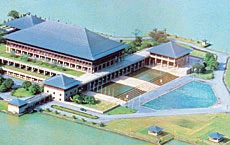
Significant political developments since its independence have evolved Sri Lanka into a multiparty democracy where people rule the country through their representatives elected at regular general elections throughout the island.
Sri Lanka, then known as Ceylon, celebrated the return of its independence on Feb. 4, 1948. It meant the end of foreign domination since 1505 when the Portuguese landed and took control of the maritime provinces. The Dutch took over from the Portuguese in 1656 and ruled for 140 years when the British took control, first of the coastal regions and later the Kandyan kingdom in 1815. The whole country then came under British rule until 1948.
With the granting of dominion status by the British government, Ceylon became a member of the British Commonwealth of Nations whose head was the queen of England. While a governor-general represented the queen, D.S. Senanayake became Ceylon’s first prime minister under the Soulbury Constitution, named after Lord Soulbury, the chairman of the Royal Commission appointed to recommend constitutional reforms. The United National Party (UNP) led by Senanayake had secured a majority at the 1947 general election when members of Parliament (MPs) — 101 in all — were elected to the House of Representatives. Being a bicameral legislature, Ceylon also had a Senate comprising 30 members.
The death of Senanayake in 1952 saw his son, Dudley, minister of agriculture taking over as prime minister followed by Sir John Kotelawela in 1955.
Meanwhile, a major challenge to the UNP government was organized by S.W.R.D. Bandaranaike, a senior member of the Senanayke (Sr) Cabinet who left the government in 1951 along with a few others including D.A. Rajapakse, member for Beliatta and formed the Sri Lanka Freedom Party (SLFP). He gave leadership to a centrist political group appealing to all groups dissatisfied with the UNP but opposed to Marxist solutions. The Pancha Maha Balevegaya — the five great forces — comprising “Maha Sangha,” (the Buddhist clergy), “veda” (native physicians), “guru” (teachers), “govi” (farmers) and “kamkaru” (workers) considered as the underprivileged sections of the Sri Lankan social fabric, rallied round Bandaranaike to inflict a crushing defeat on the UNP government in 1956.
The social revolution of 1956 saw the establishment of an indigenous identity for Sri Lanka. Sinhala became the official language resulting in the opening of doors of higher education to the less privileged children. The cloth and banian replaced the European attire. Large business establishments both local and foreign were nationalized. There was a reawakening of national art and culture. The common man got a sense of dignity and self-respect.
Just three years later, Bandaranaike’s assassination created a sense of uncertainty until his widow Sirimavo Bandaranaike was persuaded to become prime minister. Far reaching pieces of legislation were passed including the takeover of assisted schools by the state and the nationalization of vital industries like insurance and petroleum import and distribution.
Sri Lanka’s commitment to democratic ideals saw governments being changed through the popular vote and when Mrs. Bandaranaike called for a general election in 1965, Dudley Senanayake became prime minister for the third time.
The presidential system of government was introduced by promulgating a new constitution for the Democratic Socialist Republic of Sri Lanka, commonly referred to as the Second Republican Constitution.
The 1978 constitution created the executive presidency whereby the president of Sri Lanka became head of state, the head of the executive and the government. He is elected by the people for a period of six years.
The first executive president, J.R. Jayewardene liberalized the economy, encouraged manufacturing industries for export. An intensification of the separatist struggle by the LTTE led to the war in the north. The president’s effort to bring peace through the Indo-Lanka Accord agreeing to devolve power to a North-East Provincial Council was rejected by the LTTE.
Ranasinghe Premadasa was elected president in 1988 amid violence by armed groups in the south in addition to unrest in the north. Giving priority to improve the lot of the rural poor, he initiated “Janasaviya,” the poverty alleviation program to provide direct support for people of low incomes and started building a million houses to provide shelter to the homeless. Employment was created through the setting up of garment factories in the rural areas.
The assassination of President Premadasa in 1993 saw Prime Minister D.B. Wijetunga taking over as president. One year later Chandrika Bandaranaike Kumaratunga, leader of the People’s Alliance won the presidential election gaining 62 percent of the votes cast. She completed two six-year terms during which time she pursued to find a peaceful solution to the ethnic issue. While believing that a political settlement was necessary, President Chandrika continued to prosecute the war against the LTTE and succeeded in getting back the Jaffna Peninsula and pushing the LTTE to the Wanni region.