
Sri Lanka is a land of smiling people, where people are welcomed with their traditional greetings “Ayubowan” — “May you have the gift of long life!”
With this traditional hospitality, visitors to Sri Lanka are received at this “isle of delight” in a friendly and cordial manner.
From the early centuries, it has captivated visitors like Ibn Batuta, Omar Pasha and lately space scientist professor Arthur C. Clark who opted to stay in Sri Lanka. Travelers including ancient mariners and merchants to modern astronauts and business people have been seduced by the tantalizing beauty of the colors and costumes of this land which according to Mark Twain were “all harmonious, all in perfect taste”.
Arab traders who visited the island built several mosques in the island. Their first mosque, Abrar, stands as a monument of their influence in Beruwela, a Muslim town 40 kilometers from Colombo.
Today’s Sri Lanka beckons visitors to enjoy the nation’s glittering tapestry of culture and the rich abundance of nature so handsomely gathered, to give credence to the old adage — “that good things come in all small packages.”
Sri Lanka’s archaeological treasures of palaces and pagodas bear testimony to a civilization that spanned the golden age of Periclean Greece, the Roman Empire, Mayan citadels and Napoleonic grandeur. The resultant legacy is a culture embellished by the more recent influences of Western colonizers and Eastern traders, producing a mercurial mix of races and religions, arts and crafts, festivals and costumes that enchant the visitors with its exquisite variety.
Sri Lanka’s classic tropical location in the Indian Ocean gives it pleasant weather throughout the year with sunshine and rain. Landscape is incomparably lovely with verdant, lush lowlands, cascading waterfalls, azure seas, sandy beaches, abundant wildlife, riot of flowers and fruits, coconut groves, spice gardens and tea estates.
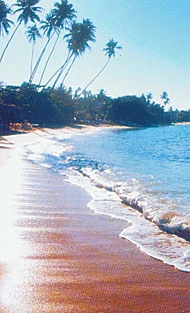
Ringing the island are miles of uncluttered white sandy beaches where sun-seekers and fun-seekers are caressed by gentle ocean breezes.
Sri Lanka was affected by the tsunami in December 2004. However, the industry bounced back recording half a million tourists by the end of 2005. The current year arrivals are expected to exceed the previous year’s numbers. The target is to receive one million tourists by 2010.
There is a phenomenal increase in investment in tourism with the positive increase in arrivals. During the fist three quarters of last year the investment made on establishments was Rs1.4 billion which has created 1,366 new employment opportunities.
At present (as at end October 2006) there are 248 hotels with 14,511 rooms. Based on the application received for new hotel projects it is estimated that the additional room capacity for 2007 will be 1,500 and it is estimated to be increased to 25,000 by the end of this decade. The hotels accept all credit cards and American Express cards are accepted at all hotels and mercantile outlets.
Rising amid spectacular waterfalls to its shrouded peaks is the central hill regions — home to world famous “Pure Ceylon Tea” gardens and the legendary gem mines that produce sapphires, rubies and a dozen other gems.
As you travel from the lowland plains to the highlands in air-conditioned coach or car, a panorama of people at work or play unfolds. Roads share space with cars, carts, bikes, bullocks and even elephants. The roadside is vibrant with life and the lush landscape presents a palette of changing colors. Pause if you would, at wayside markets, handicraft shops or batik factories or stop to watch craftsmen at work, gems being mined, tea leaves being picked, elephants being bathed in rivers or fishermen on stilts.
No trip to Sri Lanka would be complete without a visit to a hill country tea plantation, of course.
Nuwara Eliya is known as the Little England of Sri Lanka not only because of its cool climate — temperatures can get as low as 11°C — but also because of its decidedly English look. At almost 2,000m above sea level, getting to the town is an adventure in itself. There are magnificent views of mountains, valleys and waterfalls along the way.
Nuwara Eliya town is a charming place with some attractive old buildings, such as the post office; there is also the Nanu Oya railway station, which was built in the middle of the 1870s, and the Gymkhana Race Course, which was taken over by the Ceylon (now Sri Lanka) Turf Club in 1900.
Taking a train ride is a great way to enjoy gorgeous mountain and waterfall scenery and catch glimpses of old ways of life.
Peradeniya Royal Botanical Gardens located in the vicinity of the hilltown of Kandy draws more than 25,000 visitors a day. The almost 60ha gardens were established in 1374 as a pleasure garden for the ancient kings of Gampola and Kandy. Today, there are more than 4,000 species of trees, plants and creepers, some of which are very rare.
Colombo, the main point of entry, is a bustling metropolis of big businesses and small bazaars while Kandy, the last royal citadel, is the cultural center where the popular cultural pageants are held in July every year. Nuwara Eliya, one of Asia’s most scenic hill stations, has pleasant “English spring” weather all the year around.
The western coastline from Negombo, north of the Colombo International Airport, to Hambantota, in the south, shelters a string of magnificent beach resorts and quaint fishing villages. At the extreme south of the island is Yala and in the heart of the island is the Wilpattu national parks. They are sanctuaries to wild elephants, leopards, bear, deer and a host of other fauna and flora.
Cities and resorts cater to visitors, with hotels ranging from the luxury five star class international chain properties to the much more moderate-budget apartments. Most hotels offer culinary extravaganza to pamper guests with a variety of cuisine from the East and the West, as well as local dishes that reflect the elastic tastes of sea-farers, invaders and traders that came ashore over the centuries.
On arrival at the King Khaled International Airport following a weeklong visit to the island’s resorts, a recent visitor said: “I just do not know why I came back!” Every visitor to this fair isle makes sure he repeats his visit with the members of his family. Sri Lankans know no word for “goodbye.” Thus, when the time comes to leave these shores, they will not bid farewell, but invite our guests to return — again and again.