
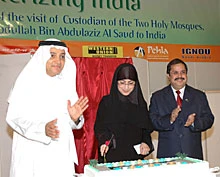
JEDDAH, 6 February 2007 — A year after Custodian of the Two Holy Mosques King Abdullah visited India in order to strengthen ties between the two nations, Indian expatriates and Saudis are solidifying that relationship on a one-to-one basis.
“We will soon have a Saudi-Indian Friendship Group,” said King Abdul Aziz University Professor Dr. Rashad Husein, who headed a large and diverse Saudi civil delegation to India to coincide with the king’s visit to New Delhi last year. Its members included Saudi women journalists and poets who brought back favorable impressions and a resolve to promote ties between the two countries.
Speaking to Arab News on the sidelines of a colorful weeklong cultural extravaganza organized last week by the Indian Consulate in Jeddah, Dr. Husein said the idea of forming a friendship group was to tap the presence of the 1.6 million Indian expatriates in the Kingdom to promote greater understanding and to build on the growing relationship between the two countries.
“We are aiming at each Indian having one Saudi friend. Meaning 1.6 million Indians will have 1.6 million Saudi friends,” Dr. Husein said of the group. “That’s a huge pool of human resources and it will definitely act as a catalyst in promoting the growing Saudi-Indian cultural, political and business ties,” he said.
Dr. Husein said the group’s formation will be finalized at a general meeting soon. “Committees and subcommittees with prominent Indians and Saudis are being formed. Its plan is being chalked out; its schedule is being drawn, and its activities are being worked out,” he said.
Although important steps are being taken by members of Saudi society, regrettably there is no similar effort in India. “Social interaction is more important than anything else. People-to-people contacts lead not only to greater understanding but solid relationships,” he said. “While Indian expatriates are excellent goodwill ambassadors for their country, we need similar steps being taken in India itself by members from all walks of the Indian society,” he said. “That will be more fruitful and more desirable.”
Indian Consul General Dr. Ausaf Sayeed, under whose tenure the Indian-Saudi relationship has grown considerably, said there was a greater momentum in ties between the two countries. “The king’s visit has given a new direction to Saudi ties with India. There can hardly be two opinions about the visit lending a new dynamism to the ties between the two countries. King Abdullah’s historic visit to India, followed up by visits of senior members of the Saudi Cabinet, is proof of the positive direction of the countries’ relations,” he said. “The increasing business ties and joint ventures in pharmaceuticals, automobiles and IT industries are proof of this growing relationship,” he added.
Dr. Sayeed and his team were pleased with the response to the cultural extravaganza in which Saudis took a big part. The events were organized to celebrate greater interaction between the two countries. All Indian cultural organizations took part in the celebrations and presented colorful cultural items from their respective states.
Keralites, who form a major part of the Indian diaspora in Saudi Arabia, presented their own unique culture through various dances and dramas. Cultural organizations from Andhra Pradesh, of which Hyderabad is the capital, presented variety shows depicting its culture and heritage.
A longtime Indian expatriate from Hyderabad and award-winning philatelist Shaikh Ibrahim displayed rare stamps and photographs of the city’s history at his show at the International Indian School, giving a throng of visitors a rare glimpse into Hyderabad’s glorious past. Hyderabad’s traditional “Chowki Dinner” was highly appreciated as well. “We wanted to present one aspect of Hyderabad’s wedding tradition to Saudis and Indians from other parts of the country,” said Hyderabad community members Sultan Mazharuddin and Shameem Kausar.
Among other highlights were the presence of famous ghazal singer Talat Aziz and TV talk-show host Karan Thapar.
“Thapar’s presence at a seminar on Indian democracy lent seriousness to the weeklong program; Aziz’s show lent a dash of color and cultural depth to the event,” said India Forum President Abdul Kader Khan. He thanked members of the Indian community, especially the teaching community at the International Indian School, for presenting a great cultural feast.
There was huge interest in the India Quiz contest. Quizmaster A.G. Danish said it was one way of popularizing various aspects of India. “The response was not only overwhelming but instructive as well. It indicates that there is appreciation for quality programs. When we think of cultural programs, we tend to think of dances and Bollywood songs. The seminar and the quiz contest proved otherwise,” he said.
The huge crowd at the grand finale was amazing. The gates of the school had to be shut only 15 minutes into the program, and that was an indication of India Week’s success. According to community member Saleem Quadri, the underlying message was simple. “Indian expatriates want to be part of the growing bonds between the two countries,” he said. “Through hard work, not only have they earned livelihoods for themselves, but they have created a good name for their country — and they will be the bedrock of this burgeoning relationship.”