
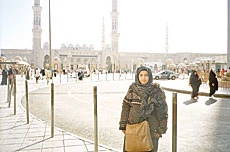
NEW DELHI, 10 February 2007 — The image of a Hajjan Bibi, that is a Hajja or a woman Haji, in most Indian circles is that of an elderly silver-haired woman with age seething from her wrinkled face, stooping shoulders and weak knees that forces her to use a walking stick. This is because here in India, the general attitude of regarding Haj as a post-retirement exercise still prevails. Not surprisingly, when the invitation to perform Haj from the Saudi king was extended to me by Saudi envoy to India Saleh Mohammed Al-Ghamdi I had enough reason to be in a fix.
Apart from still not being considered as having aged enough for Haj, I was faced with another dilemma. Being a woman — a single one at that as well — posed for me the dilemma of going to the pilgrimage without a mahram. However, this apprehension eased on learning that this condition did not apply to women going in a group. I was to go for Haj in a group of around 35 Indians that included six women. Nevertheless, given the stunned reaction of my near and dear ones on learning that I was heading for Haj, there was a few brief moments when even I was musing over whether or not to go. Yet, not dissuaded and armed with a few Indian dresses and long cloaks to cover me from head to toe during the pilgrimage I headed for the Kingdom with the group.
Back home, still coming to grips with now being referred to as Hajjan Bibi in certain circles, I have chosen to reflect on the other side of this phase. There cannot be two opinions about this Haj-phase that has heralded a new opening at several levels — diplomatically as well as socially.
Though, an Indian group of delegates that is selected by the government each year heads for Haj, this was the first time that an Indian group was invited by the Saudi government — a move welcomed by India. The message is obvious. Both countries are keen to further strengthen their bilateral ties and therefore want to give due importance to enhancing people-to-people interaction.
What also stands out is the importance being accorded to women at this level. It may be noted that this trend was also visible ahead of the Saudi king’s visit to India last year as the chief guest of the Republic Day parade. At that time there was a civil delegation here with a significant number of ladies.
Each woman was included in the delegation on strength of her own individual identity, whether as a journalist, a businessperson, a poetess, an academic or for some other distinction in another field. The decision to continue this trend was marked by the inclusion of women in the Haj group as invited by the king. It is time that the world definitely started paying a little more attention to the distinct importance held by Saudi ladies on their own terrain.
Against this backdrop, while in Saudi Arabia, I didn’t miss an opportunity to notice Saudi women playing a key role there as well. As security guards in women’s prayer sections in Madinah, women play a crucial role in checking female pilgrims and also ensuring that no particular section gets overcrowded. This point deserves special attention since at pilgrim sites it is common to see overcrowding and people tumbling on top of one another.
What stood out was the deftness with which these ladies use their body language and one word, “la, la,” to hold women pilgrims from across the world at their command. Some credit must be given to these ladies and also to the ones looking after the food and accommodation of female Hajis. This is especially the case since this year’s Haj was conducted in a peaceful fashion without any incident. Of course, an equally important role was played by the rest of the Saudi team, who were constantly on alert for potential security risks and displayed concern for Hajis striving to ensure their comfort. If, before the Haj began, at stake were the Kingdom’s diplomatic, political and religious credentials, the Haj’s peaceful conclusion spells only success along the same lines.
The significance of this point stands out when it is remembered that not just thousands but millions of pilgrims from across the world were engaged in performing Haj. There was the massive human chain. With intense devotion written on the faces of these people, one could see them deeply involved in Tawaf, Sa’ei, prayers at Makkah and Madinah and in throwing stones at the Jamarat. At test was the devotion by which the pilgrims had all their prayers pinned, the moments for which they had waited for months, perhaps even years and even maybe almost their entire lifetime.
Such was the aggressive metabolism involved in the human chain that was engaged in Haj that although each pilgrim may have been a stranger to the one he or she was rubbing shoulders with, all the pilgrims seemed to move along together faultlessly, at peace with each other and chanting similar prayers and supplications. Each was guided by a sense of religious serenity of the peace and calm binding all in one direction. Yes, for me a part of this exercise and each of these moments bears much-treasured religious and spiritual significance.
The Haj visit also enabled me to stop at Jeddah before returning to India, which bears its own personal charm and a lot of emotional warmth. This made it possible for me to step into the Arab News office, a paper with which I have been associated with for 15 years. I also met the team there, most of whom I had only been in touch with through e-mail and telephone. My stop at Jeddah also ensured my first ever meeting with my uncle (father’s younger brother) who had settled in Saudi Arabia and who flew to Jeddah from Jizan to meet me.
The Haj diplomacy carried the message that steps are being taken to ensure women play a greater role at the diplomatic as well as the national level. Definitely, it is time to cease viewing Indo-Saudi relations as linked only to oil. It is also time to stop viewing Saudi women as non-significant entities behind the veil.