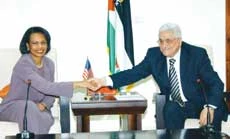
GAZA CITY, 19 February 2007 — Palestinian President Mahmoud Abbas held talks with US Secretary of State Condoleezza Rice yesterday defending his unity deal with Hamas after US and Israel threatened to shun a coalition government.
However, a joint press conference scheduled after the meeting was abruptly canceled without any explanation.
Pledging to continue to “probe the diplomatic horizon,” Rice traveled to the occupied West Bank to meet the moderate Palestinian leader just hours after Israeli Prime Minister Ehud Olmert said prospects for peace had dimmed.
Rice, Olmert and Abbas are all due to meet in Jerusalem today, but no joint news conference is planned — a sign that expectations are low.
In Riyadh, Custodian of the Two Holy Mosques King Abdullah thanked Palestinian leaders including President Mahmoud Abbas of Fatah and Khaled Meshaal of Hamas for showing forbearance and magnanimity in reaching an agreement in Makkah in order to end their fratricidal fighting.
Abdullah made this comment while receiving the chairman and members of the Human Rights Commission. “I invited Palestinian leaders to Makkah after praying to God. By the Grace of God, they came here and reached an understanding because their intention was good,” the king said. While cautioning Palestinians against their “belligerent and spiteful enemy,” the king promised them Riyadh’s unwavering support.
The deal in Makkah ended weeks of internal fighting that killed more than 90 Palestinians. But Western officials said the agreement fell short of meeting policy terms set by international mediators.
“Abu Mazen (Abbas) specified (to Rice) that his paramount, cardinal interest is to end the Palestinian inner-fighting, to end the chaos and lawlessness,” said Saeb Erekat, a senior Abbas aide.
With Abbas seated at her side at the start of the 2-1/2 hour meeting, Rice said she hoped today’s trilateral talks would be “an opportunity to understand the current situation and commit and recommit to existing peace agreements.”
Olmert told his Cabinet that US President George W. Bush had agreed in a telephone call on Friday to boycott Abbas’ planned unity government with the Hamas group if international terms were not satisfied.
The Quartet of Middle East mediators, comprising the United States, the European Union, Russia and the United Nations, have insisted that any Palestinian government must recognize Israel, renounce violence and abide by interim peace accords.
“A Palestinian government that does not accept the Quartet’s conditions cannot receive recognition, and there will not be cooperation with it,” Olmert, due to see Rice later in the day, said in broadcast comments.
Palestinians had also hoped the power-sharing pact, which contained a vague promise to “respect” previous peace deals, could persuade Western donors to restore direct aid cut off to the Palestinian Authority after Hamas won election a year ago.
At the start of her talks with Abbas, Rice said she looked forward to hearing more from him on the unity arrangement. Abbas said he and Rice would discuss the Makkah agreement and explore “the horizon for the peace process” at today’s talks.
Earlier, in talks with Israeli Defense Minister Amir Peretz, Rice was asked whether there was agreement to boycott a unity government. She did not respond, although she said on Saturday such a decision had not yet been made.
Senior Palestinian officials said Abbas replied angrily to a US official who warned him on Saturday that Washington would have no contact with unity government ministers, including Fatah members, if the Quartet’s terms were not met.
“President Abbas...shouted (at the official), saying: ‘You are placing pressure on me. I have internal pressure — the pressure is unbearable. The only alternative to this agreement is civil war’,” one Palestinian official said.
Abbas tried to persuade Rice to give the Hamas-Fatah coalition a chance, his aides said.
During the meeting, Rice said the US position is unchanged, a senior American official said, speaking on condition of anonymity because the talks were private. He said the US would withhold judgment until the Palestinian government is formed. “We will reach our own conclusions,” he said.
The Palestinian officials said Abbas, in turn, told Rice that his deal with Hamas was the best he could get, suggesting it’s unlikely there will be a change in the government’s program. The officials spoke on condition of anonymity.
In the northern Gaza town of Beit Hanoun, Palestinian Prime Minister Ismail Haniyeh of Hamas accused the US and Israel of trying to sabotage the Palestinian unity deal which has helped halt months of deadly fighting.
Addressing some 2,000 supporters, Haniyeh also said he would go ahead with forming the coalition government. “The American and Israeli interference today aims to destroy the basic principles and the basis of the Palestinian cause...and to divert our cause,” he said.
Today’s summit was initially billed as an attempt to revive long-stalled peace talks. But friction over the power-sharing deal has eclipsed that.
— With input from agencies