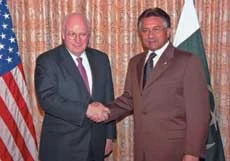
ISLAMABAD, 27 February 2007 -— US Vice President Dick Cheney sought Pakistan’s increased cooperation and support to combat a new Taleban offensive in Afghanistan and a resurgent Al-Qaeda, during an unannounced visit to Islamabad yesterday.
“He asked President Musharraf that Pakistan should do more,” a Pakistani official said after the meeting between Cheney and Musharraf at the president’s house.
“Cheney expressed US apprehensions about the regrouping of Al-Qaeda in the tribal areas and called for concerted efforts in countering the threat,” an official statement said after the meeting.
The US vice president also communicated “serious US concerns on the intelligence being picked up of an impending Taleban ‘spring offensive’ against allied forces in Afghanistan,” the statement said.
“Cheney, however, appreciated Pakistan’s efforts and steps being taken to combat terrorism,” the official added. Cheney arrived under tight security after spending the night in Oman and left for Kabul after lunch with Musharraf.
The United States is bolstering its troop presence in Afghanistan by 3,200 to help repel fierce spring fighting anticipated by the United States and NATO after the bloodiest year there since the Taleban was ousted by US-led forces in 2001.
Cheney’s trip came as the New York Times quoted senior US officials saying Musharraf would get an “unusually tough message” that US aid could be slashed unless Al-Qaeda is hunted down more aggressively. “He’s made a number of assurances over the past few months,” one official told the paper. “The message we’re sending to him now is that the only thing that matters is results.” The Pakistan statement said Musharraf had called on Pakistani, Afghan, NATO and US forces to take “joint responsibility” for stopping illegal crossings along the 2,500-kilometer border with Afghanistan.
He also defended a controversial peace deal with Taleban militants in the North Waziristan tribal region that was signed in September. He said political and administrative efforts in the tribal areas “would help curb Al-Qaeda and Taleban activities and avert any Talebanization in the area.” Cheney’s trip was not announced ahead of time for security reasons.
The New York Times said the new Democratic majority in the US Congress was looking at cutting aid and military assistance to Pakistan, the fifth-largest recipient of US foreign aid, unless it does more to take on Al-Qaeda.
Musharraf “expressed concern on the proposed discriminatory legislation” in Congress, the Pakistani statement said.
Pakistan has been fighting guerrillas based in its tribal lands and Musharraf says Taleban fighters do operate from Pakistan, but says the militants’ leaders are in Afghanistan. “The president made it clear to Cheney that Pakistan is doing its best and militancy and violence are Afghanistan’s problems and their roots are there, not in Pakistan,” the Pakistani official said.
Musharraf has warned that the conflict could deteriorate into a “people’s war” unless President Karzai’s government in Kabul does more to win over alienated ethnic Pashtuns living in the region.
Although Bush publicly praises Musharraf’s support on counterterrorism, US officials have voiced frustration over Taleban sanctuaries on the Pakistani side of the porous border with Afghanistan.
Cheney flew into the US military base near Bagram, about 60 kilometers north of Kabul, later yesterday and had been expected in the capital for a meeting with President Hamid Karzai, but the meeting was canceled.
Bad weather forced the cancellation of the meeting planned between Cheney and Karzai, the president’s office said. “It was canceled because of the bad weather,” presidential spokesman Khaleeq Ahmad said. Snow and rain have been falling throughout the day.
Asked if the leaders could meet today, Ahmad said “most likely.” The media office at the Bagram base could not immediately comment.