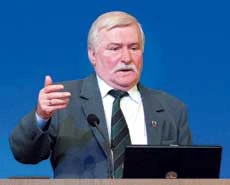
JEDDAH, 28 February 2007 — In an inspiring speech that gave the delegates to the Jeddah Economic Forum a glimpse of the power of the man who rose from electrician to president of Poland and dealt a terminal blow to the monolith of communism on the way, Lech Walesa challenged the delegates with his vision of the future of the global economy.
The speech, wide in scope and ideas and peppered with anecdotes and earthy imagery, by turns produced applause and sharp intakes of breath from a captivated audience.
“A lot has been said about business here — the economic system in the world now will not be sustainable in the 21st century — because there are too few owners to defend the current system.”
He pointed out that less than 10 percent of the world owns 90 percent of the wealth and that this was simply not sustainable. “To survive this century, we need to at least triple the number of stakeholders by looking at other forms of ownership so that we prevent the people from supporting and voting for populists and demagogues.”
Walesa drew on his personal experience and the history of Poland, sandwiched between two powerful nations and written off by the world when under Soviet communist rule.
“We tried at the end of the war to warn the world about Stalin and the fact that he was going to install a bad system on the world,” said Walesa. “We could not protect ourselves. Communism sat badly on the Polish character, like a horse’s saddle on a pig.”
He reflected that when two superpowers existed — “the empire of evil and the empire of good” — they disciplined each other. “Now the ‘evil’ has collapsed, what is the position of the empire of ‘good?’” he asked.
He noted that the United Nations was an institution of great merit but bound in red tape and very ineffective. The remaining superpower — not once did he refer to the United States by name — was “an extremely effective superpower when it defends its interest and perhaps somebody else’s on the way if it doesn’t get in the way.” However, this superpower lacked the authorization and empowerment to act on behalf of the world.
“There is no doubt that this superpower is a military and economic leader to the world, however it is certainly not a moral or political leader to the world, and the world lacks a leader.”
The institutions and structures in the modern world Walesa thought were no longer relevant and to reform them a lot of debate was needed based on the grounds of the achievements of mankind and the lessons learned in order to make platforms and systems that are relevant.
“We see in your country so many striking values that would be applicable to those structures,” he told the delegates.
Poland was written off by the world when it was occupied by the Soviet Union. Walesa said that based on the calculation of other nations, there was no way to shake off the Soviet yoke.
“However, a few individuals — me included — said there had to be a way out but leaders of the world gave us no chance at all; only a nuclear war could change the status quo.” The point of his story was, to show where the error was in all their calculations. “When you engage in speculation about your future and that of your country, you should realize where the error in these calculations was. We calculated tanks, dollars and missiles. What we overlooked were the values, the spirit and God. We neglected these totally.”
Walesa detailed the failure of the Soviet attempt to reform the Communist system through perestroika and glasnost, locating the beginning of the downfall to the visit to Poland of Pope John Paul II — the first Polish pope. “That guy (Gorbachev) who failed received a Nobel Peace Prize,” said Walesa. “I want you not to feel discouraged with any failures that fall upon you; you could win a Nobel Prize!”
Walesa said that relationships between countries with fixed territorial boundaries once revolved around war and dominance. Now, with globalization on us, enemies had become consumers and instead of keeping potential enemies poor and weak it was in each country’s self interest to keep them rich enough to buy products.
“Even though the capitalist system does this, bear in mind one thing,” he said. “The communist system does not work. Capitalism is not ideal but it is effective in some countries — all we have to do is improve it and enlarge the number of stakeholders. We must stop thinking in terms of single countries — but in regions and of the globe.”