
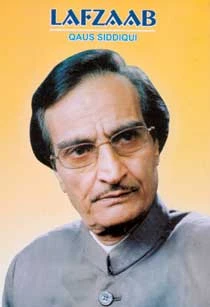
HE is markedly different from other traditional poets. In fact, he inspires admiration and loathing in equal measure because of his linguistic experiments. His ambition, single-minded determination and self-confidence are worth examining in “Lafzaab.” Qaus Siddiqui, an Indian Urdu poet, has taken many risks in his collection of ghazals but as he is a wordsmith, the risks were necessary. The result is heart-warming and thought-provoking.
In the book’s preface, he claims that his poetry transcends modernism and postmodernism. Monotheism is his soul and is also his axis. Like all natural poets, his poetry is a collection of thoughts and the spontaneous overflow of powerful feelings. This poetry, he says, provides him and his reader with both delight and wisdom. He is indeed monotheistic but is not opposed to the values of other religions for he knows that a valueless society breeds moral anarchy and makes an ordered and satisfying life impossible. The following lines contain the question and the answer:
Be aqeeda zindagi mein kuchh nahin rabte lateef
Ab pujarin phool ki thali kahan le jaayegi
(Life without belief does not have the delicate relation
Now where would the priestess go with her flowers?)
The “rabte lateef” (delicate relation) says it all. Such perceptions are typical of his poetry. Qaus says:
Sheriyat sher mein laazim hai ki yeh nasr nahin
Ai Miyan Qaus bharam kuchh to ghazal ka rakhiye
(The poetry should not be prosaic, without subtlety and refinement ghazal loses its face.)
Although the poet gives much importance to his experiments in coining words and terms, I was not much impressed by this particular aspect of his work. What drew my attention to his book was his originality as a poet. As professor Wahab Ashrafi, in his essay regarding Qaus’ book says, such experiments, as in the case of Anis Nagi and Zafar Iqbal, received cool reception from the public. Sometimes the experiments were laughed at because newly coined words are like newly minted coins which the public is slow to accept. As a new ruler finds it difficult to introduce his coinage, a poet and a playwright also have to wait for acceptance. Since the book is full of new words I will not produce examples for the reader but I will say that if Shakespeare had to wait, then Qaus should wait and watch. But as a natural poet, Qaus has a great appeal. He is delicate, well-informed, skilfull and humane. He is thought-provoking when he says:
Ik lafz bhi phaile to mera saibaan ho jaye
Rakkha to hai likh likh ke kitabon mein bahut kuchh
(When a word expands it becomes like a shade for me
The books have lots of words!)
The words show brilliance and genius. One must be grateful to our ancestors who left these great treasures in different languages. Their sacrifices gave us culture and civilization without which we would not have been more than beasts under the sun.
Qaus’ poetry bears witness to the changes in the realm of ghazal during the past four decades. In this book the traditional ghazals with newer experiments fill us with a sort of amazement. His indulgence and passion for a sound sleep gave him sleepless nights:
Shauq bus ek neend ka tha magar
Umr bhar ka woh ratjaga thehra
What is sleep but a natural, regularly recurring condition of rest for the body and mind, a condition of no conscious thought but sometimes of dreams and reflections. How many of us sleep well? Sleep often eludes us. It seems as if it has a deep meaning for poets such as Qaus who have a deep sense of belonging to all life. In the pursuit of happiness and serenity he finds loneliness and anguish:
Sannaton ke khoonin chehre, tanhai ka nangapan
Raaton ki zahrili hawaain, khwabon ke diwaro dar
It seems the poet has become a solitary reaper. His dreams have turned into nightmares. His soul bursts into deep wailing. His loud cry pierces the heart. The Industrial Revolution changed the faces of different societies. Sorrows, sufferings, frustrations, dejections and a deep sense of loss fill the human heart. The pace of progress has made human beings lonelier than ever. The value system of joint families has evaporated. These bitter experiences creep into Qaus’ poetry:
Aaj bhi mitti ka bartan hai bahut hi qimti
Ab bhi isme jazb hai takhleeq ka gham bepanaah
(The clay pot has pains of creation so still it’s very valuable.)
This clay pot tells the tale of civilization and the clay has become human nature. But the Iron Wheel of the Industrial Revolution crushed the human soul. Now in this golden age of lies, deceit and perfidy, the soul, like a lonely child, is crying in the darkness.
Kisi bhi aahat pe haadison ka guman hona bhi haadisa hai
Ai Qaus aisa bhi koi dil hai jo khwab mein chaunkta nahi hai
Kitni aawaazon ka qatil hai yeh jungle ka sukoot
Mera ehsaas bhi takra ke shajar se lauta
Kuchh itni sho’la badan thi sukoot ki garmi
Tamam jisme sada tar ba tar dikhaai diya
Yeh jo hain masoom chehron per sawalon ke nishaan
Padh inhen, hain aane wale inquilabon ke khutoot
Lamha lamha hai safarbar ke aahista na chal
Tez hai waqt ki raftar ke aahista na chal
Jo apne ahd ki tarikh ka katba nahin hota
Woh chehra asl mein insaan ka chehra nahin hota
Suna hai ik badi taufiq hai lab ka lahoo karna
Her ik iqrar mein aawaz ka dariya nahin hota
Now the daydreams are shocking. The silence of the jungle is churning our soul. The silence is so hot that our soul is melting. The innocent faces have the interrogation marks on them that are pointing toward a great change. The journey of life has become so fast that any delay will cause irreparable loss. These are echoes of time that are available in the above lines. “Lafzaab” is full of such ideas. The realism of a natural poet, in this book, on each step takes us to new horizons where the whole cosmos can be easily observed.
I hope “Lafzaab,” which was published by Dansih Markaz, Phulwari Sharif, Patna, will be a journey to the inner self for its readers as the poet himself declares his poetic journey successful.
Chal pada hoon main aap apni taraf
Yeh safar kamiyab thahre gaa