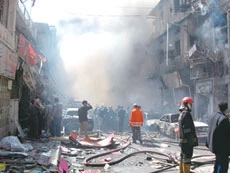
BAGHDAD, 6 March 2007 — A suicide car bomber devastated Baghdad’s historic booksellers’ district yesterday, killing 30 people and setting shops and cars ablaze in defiance of a US-backed crackdown on violence in the Iraqi capital. A thick plume of choking black smoke rose over the city after the attack, the deadliest to hit Baghdad in a week.
US and Iraqi forces extending a major push into the key Shiite militia haven of Sadr City met little resistance. American troops arrested a leading figure in the Mehdi Army militia and three of his aides, the militia said. The bomb was another challenge to Prime Minister Nuri Al-Maliki, who has been pleased with the early results of the three-week-old security operation.
A Reuters witness said ambulance sirens were sounding and the scene was in chaos, with pools of blood on the pavements and shop fronts destroyed, mangled debris littering Mutanabi Street. “There was so much smoke that I was vomiting,” said the witness, who was in a book shop on the street when the windows were blown out by the blast. The witness, who works for Reuters, requested anonymity.
As firefighters doused the flames, which reached up to the third story of some buildings, papers and book pages fluttered on the ground, some blackened, others bloody. Charred bodies lay almost unrecognizable, half buried in the rubble of shop-fronts. The bomb exploded around 50 meters from the Shah Bander cafe, a beacon of Baghdad’s once thriving literary life.
“There are many shops set on fire and more than 15 cars were burned out,” said the witness, adding he helped several casualties into a truck that took seven people away to hospital. “They were covered with blood,” he said. Police said the blast wounded 65 people. Three witnesses said it was a suicide car bomber.
Iraqi and US forces have stepped up operations in Baghdad aimed at stemming sectarian violence. A big increase in the number of troops on the streets and checkpoints appears to have reduced death squad killings but US commanders say car bombs remain a problem.
Abu Ali, a guard at a building where the ground floor was burnt out and several people killed, said he was inside when the car exploded. “I don’t know where my sons are, I heard they were wounded but I haven’t seen them,” he said, clearly distraught. He later discovered one of his sons was killed.
More than 1,000 US and Iraqi troops pushed into the Mehdi Army militia bastion in Sadr City on Sunday, searching homes for illegal weapons and opening a new front in the Baghdad plan. The Mehdi Army is commanded by Moqtada Al-Sadr, and the operations in Sadr City could test Iraqi and US determination to enforce a crackdown regarded as a last attempt to stop Iraq sliding into all-out civil war.
Washington has called the Mehdi Army the greatest threat to security in Iraq, but its leaders seem to be lying low, unlike in 2004 when the militia twice rose up against American forces. US forces yesterday arrested leading Mehdi Army figure Hussein Al-Asati in the nearby Shaab district together with three aides, said Abu Firas, another senior militia official.
In another development, a top member of Saddam Hussein’s former regime claimed yesterday there “was no genocide” against Iraqi Kurds and blamed Iran for an infamous poison gas attack in 1988 on a Kurdish town.
Tariq Aziz, whose posts included foreign minister and deputy prime minister, told a special tribunal that Iraq did not possess the lethal nerve agents used to kill an estimated 5,600 people in Halabja — which later became a worldwide symbol of the Operation Anfal campaign against the Kurds in northern Iraq.
Aziz said such chemicals were held by Iran, which battled Saddam’s regime during a 1980-88 war. “You can check with experts,” he told judges overseeing the trial of six former Saddam officials charged with various crimes against humanity for the 1980s crackdown on Kurds that killed an estimated 100,000 people.
“There was no genocide against the Kurds... Those defendants were honest officers who defended their country and fought Iran,” said Aziz, who appeared as a defense witness.
He also called Saddam a “hero and patriot for Iraq sovereignty.” Saddam was hanged Dec. 30 after being convicted for the killing of 148 Shiite Muslims after a 1982 assassination attempt.