RIYADH, 30 March 2007 — Saudi Foreign Minister Prince Saud Al-Faisal warned of the consequences a strike against Iran regarding its nuclear program would have on the Middle East region.
“The news of any war in the Gulf would have a large impact on the region,” he said, adding that every country in the region was taking “its own precautionary measures” to defend itself.
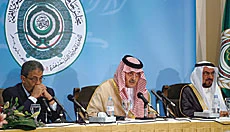
Addressing a joint press conference with Arab League Secretary-General Amr Moussa after the conclusion of the 19th Arab Summit here yesterday, Prince Saud ruled out any differences with Libya regarding its boycott of the summit.
“Saudi Arabia has no problems with Libya,” he said. “Libya has problems with Libyans,” he added, to the applause of journalists. “There were problems in the past ... but that was long gone and had been resolved. We do not have any problems now.”
Prince Saud said it was not a surprise that Israel rejected the Arab peace initiative, which was relaunched in the Arab summit.
“This has always been its stance whenever a serious and vivid peace initiative is proposed,” he said. “It signals that it is a country that does not want peace.”
Commenting on mechanisms of implementation of the Arab peace initiative, Moussa said that the Arab world was now waiting from the United States to play its peace-broker role in the region after the revival of the peace initiative by the Arab summit.
“We will give enough time for the American initiative to produce whatever they can produce if they are serious,” he said. “We will give them the benefit of doubt.”
He said only by time would Arab leaders then be able to sit down and discuss what steps they would take after the American one. “It is serious. And we have to sit together to decide a new course of action if our assessment would lead us to believe that all this is nonsense,” he added.
Prince Saud denied that the Arab peace initiative would have a timeframe. “This is not possible. It does not have a timeframe,” he said. “As soon as Israel finishes its negotiations with the countries whose lands it occupies, Arab countries will sign a peace accord with Israel . . . If the signing takes place next year, it will take place next year.”
He said the purpose of relaunching the Arab peace initiative was to confirm Arab states’ stance on the Palestinian-Israeli conflict in the international arena.
Prince Saud said the Custodian of the Two Holy Mosques King Abdullah was candid in his description of the situation in Iraq, where he described the US-led occupation as “illegitimate”.
“King Abdullah does not avoid realistic issues for diplomatic reasons,” he said. “He is candid and transparent.”
Prince Saud denied that the Arab summit had any conflicts or did not live up to the standards of the Arab nations. “There was a great deal of agreement,” he said. “They did not leave anything out in their discussions. Their discussions were frank and transparent that had overcome all of the previous obstacles.”
On his part, Arab League Secretary-General Amr Moussa said the Arab League was successful in getting funds to the Palestinian government, despite the economic embargo imposed on it.
“During the embargo, The Arab League transferred over $120 million to the Palestinian government. In addition, Arab states have also donated some $450 million during the embargo, much of which was represented in medicine, clothes, foodstuff,” he said. “Despite the embargo we were persistent in our work and were successful to overcome it.”
He lauded many European states that have decided to disregard the economic embargo and continued their financial support to the Palestinian government, such as Norway, Sweden, and Spain.
“I urge all European Union countries to follow suit,” he said. “The international community should support the Palestinian people and uplift this embargo which does nothing but serve the occupation force.”
Asked about the Kingdom’s stance on the 15 British soldiers who are withheld with Iranian officials, Prince Saud described it as “unfortunate.”
“We do not need any things to add to the already inflammatory situation in the region,” he said. He said he extended his heart out to the families of the captured British sailors.
Moussa also said the summit was successful in many respects as it took a number of important resolutions in the areas of politics, economics, education, social development and security.
Speaking about the peace initiative, Moussa said: “Once Israel completes its negotiations with the concerned parties, the Arab countries will sign a peace agreement with Israel ... There is no timeframe for this.”
The summit leadership also:
• Rejected unilateral US sanctions imposed on Syria;
• Urged member countries to complete measures to create a greater Arab free-trade zone;
• Called to speed up measures to facilitate transportation links among member states by air, land and sea;
• Called for the implementation of the Arab project to improve health facilities;
• Urged Arab governments to review a report on educational development in order to present it at the next summit;
• Approved the strategy for sustained agricultural development;
• Endorsed a framework for the executive program for Arab customs union; and
• Agreed to teach nuclear science and technology at Arab universities and set up nuclear plants for scientific research and use the research for economic and health purposes.