ISLAMABAD, 14 March 2007 — Pakistan’s suspended Chief Justice Iftikhar Chaudhry challenged the judicial panel considering complaints against him at a hearing yesterday as opposition swelled to the government’s move to sack him.
Appearing before the five-member Supreme Judicial Council (SJC), Justice Chaudhry said, “I am still the chief justice of Pakistan and my suspension under Article 209 of the Constitution is unlawful.”
In a handwritten eight-page statement Chaudhry challenged the composition of the SJC saying it was not headed by the next senior judge, Justice Bhagwan Das, that two judges were biased against him and that the other two members of the panel were facing references, which made their integrity doubtful.
“I am of the opinion that SJC is not duly constituted and is incapable of holding an inquiry against me,” he said.
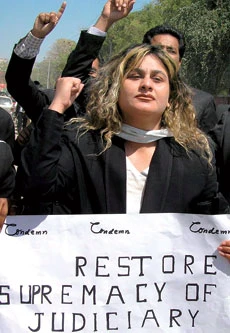
Lawyers across the country have staged angry protests since President Gen. Pervez Musharraf’s government suspended Chaudhry on Friday.
The government has given no details of allegations against the suspended chief justice but analysts said the action might be related to his efforts to make authorities account for people who disappeared after being taken into custody.
Chaudhry was confined to his home in Islamabad since Friday, with police blocking most access to him, although the government denies he is under house arrest.
Yesterday, he initially declined a ride in a government car to the nearby Supreme Court and said he would walk. He was later taken to the court under tight security for the closed SJC hearing.
Chaudhry’s car was thronged by supporters as he approached the court and police had to escort him on foot.
The suspended chief justice has demanded a public hearing, saying the accusations against him were unfounded and not sustainable. Chaudhry left the court to cheers and clapping from his supporters who also chanted anti-government slogans. The hearing will resume on Friday, said his lawyer, Munir A. Malik.
Malik, president of the Pakistan Bar Council, said Chaudhry was in good spirits: “His morale was higher than mine.”
The suspended chief justice is also represented by Aitzaz Ahsan, Tariq Mahmud and Hamid Khan, a former judge of the Supreme Court. Khan had resigned when Musharraf declared himself president and asked the judges of the superior courts to take fresh oaths under the Provisional Constitutional Order (PCO).
Earlier, about 200 lawyers and liberal party supporters protesting outside the Supreme Court were joined by rights activists and the leader of an alliance of religious parties who said the government had acted unconstitutionally.
“There’s no constitution, no rule of law in the country,” said Qazi Hussain Ahmed, of MMA.
Police and lawyers clashed in the city of Lahore on Monday and about 25 people were hurt. As well as Islamabad, protests took place in Lahore, Quetta, Peshawar, Hyderabad and Kashmir yesterday. The uproar has contributed to uncertainty on Pakistan’s main stock market, dealers said.
The government said on Friday the SJC would inquire into “numerous complaints and serious allegations” against Chaudhry, APP news agency reported. The state-run agency also cited “misconduct and misuse of authority.”
In the morning, Chaudhry was taken to Balochistan House where former Prime Minister Mir Zafarullah Khan Jamali asked him to resign, but he refused.
US-based Human Rights Watch said that by “brazenly and unlawfully dismissing” Chaudhry, the government had created a constitutional crisis and undermined the independence of the judiciary.
Human Rights Watch said the move to oust Chaudhry pointed to government determination to control the judiciary in the run-up to elections due late this year or early next.
— With input from agencies