
ALKHOBAR, 20 March 2007 — Samsung has appointed Axiom Telecom as the key distribution partner for its mobile phones in Saudi Arabia. Under the terms of the agreement, Axiom Telecom will distribute Samsung’s wide range of mobile handsets and accessories across the Kingdom. Axiom Telecom is the largest retailer and distributor of mobile and wireless solutions in the Middle East.
In Saudi Arabia alone, Axiom Telecom has more than 170 outlets, plus more than 400 outlets across the GCC and Egypt. Axiom has direct partnerships with the world’s leading mobile brands. In addition to mobile retail and distribution, Axiom Telecom is a partner of Saudi telecoms service provider Mobily, as well as regional satellite service provider Thuraya. It has the region’s largest service center infrastructure and has won numerous customer service awards.
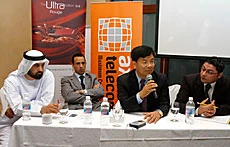
At a press conference held at Sunset Beach Resort last Tuesday, Dong Eon Lim, Samsung’s senior manager, Middle East and Africa HQ, and Najib Ibraheem Al-Zarooni, Axiom Telecom’s VP Saudi Arabia, discussed the new agreement.
“Worldwide, Samsung is in third position among mobile manufacturers and 90 percent of our mobiles are sold outside South Korea. In the Middle East, in most of the countries, we are No. 2,” Lim said. “In 2006, Samsung had a market share of 17 percent in the Middle East and Africa region. It is a challenge for us to grow our market share in Africa because Samsung focuses on the middle and high-end handsets and lower cost handsets are more in demand in African nations. But our handsets are very attractive to most consumers in the GCC. So we thought that in a market such as Saudi Arabia, where the population has the means to afford such models and the market is growing very fast, Samsung’s market share should also be growing rapidly. But that hasn’t been happening for us. We’re stuck at 10 percent market share. So it’s time for a change.”
According to Lim, Axiom Telecom is operating the type of outlets where Samsung handsets can be positioned well. Its retail shops are in premium, high profile locations that tend to attract consumers interested in high-end handsets. Axiom also has a strong focus on accessories and Lim admitted that many people had been reluctant to purchase Samsung mobiles in the past because Samsung accessories were not readily available in the Kingdom.
Since Samsung has made the move to Axiom early in the year, they are hoping to take at least 25 percent of the Saudi handset market in 2007 and hope to reach 35 percent of the market by 2008. This may seem ambitious, but it is not impossible.
“In Turkey in the year 2005, we sold almost 600,000 handsets,” Lim said. “Last year we sold 1.7 million handsets. So once the channel strategy is well developed, it is possible to make big jumps. We have many form factors coupled with 3G, 3.5G and even music, business and gender focused handsets, that we believe Samsung can offer a superior product for every requirement.”
Najib I. Al-Zarooni, Axiom Telecom’s VP Saudi Arabia, stated that Axiom is committed to helping Samsung increase market penetration. However, Samsung’s rise in the Kingdom will most certainly lead to other handset vendors losing at least some market share.
“We all know that in the Middle East, Nokia has a big share of the handset market,” Al-Zarooni remarked. “Many users prefer the Arabic versions of handset interfaces that Nokia creates and Nokia gets new phones into the market quickly. Many consumers also used to prefer bar phones to other handset form factors since they were considered to be more durable. Plus, Nokia brought Bluetooth handsets into the Middle East market before other vendors.”
He continued, “Now, the handset market is changing. In the Middle East, Nokia had well over 60 percent market share but that figure is falling. They are getting more competition from Sony Ericsson and Samsung on the high end and Motorola is driving against them on the lower end. It will not be as easy a ride for them as in the past. At Axiom, because we are multi-brand, we can really see how the situation is changing for Nokia. The market share split among handset vendors has completely changed in our outlets. In the past, 70-75 percent of the handsets that Axiom sold were from Nokia. Now that’s down to perhaps 50 percent. The competition between the brands is good for the consumer, so we welcome it.”
To keep up with the changing tastes of consumers in the Kingdom, Axiom Telecom is updating its shops. Since Axiom represents Nokia, Samsung, Sony Ericsson, Motorola and LG, the company has decided to give each brand its own section of each outlet. Al-Zarooni believes that this concept will make it easier for consumers to see what’s available for each brand and he hopes that it will also encourage the manufacturers to offer full lines of devices and accessories to the market in order to remain competitive.
The size of the Saudi market is between six and seven million handsets per year and Al-Zarooni stated that last year, Axiom Telecom’s sales in Saudi Arabia were about 55 percent of the Kingdom’s market. Growth and competition in the Saudi market has served local consumers well by driving down the prices of handsets.
“When Axiom entered Saudi Arabia three years ago, the price of handsets in Dubai was less expensive than here, but not anymore. Our margins were higher back then. The Saudi government has reduced the customs duty too, and there is more competition,” commented Al-Zarooni. “For example, Nokia has four distributors in this market so there is a lot of competition and its handset prices have come down. When we look at the numbers of handsets sold here, it is many more than Dubai. If you sell 10 of one handset in Dubai, you’ll sell 40 of the same handset in Saudi Arabia. Large quantities help push down prices.”
Many international telecom analysts have speculated that with the awarding of a third GSM license, the Kingdom’s consumers could benefit from competition in a new way — through handset subsidies. Al-Zarooni doesn’t see that happening.
“I don’t think that operators here would like to go to subsidies. Both operators in Saudi Arabia are making a high-profit margin on their services and they don’t want to compromise on that. Nokia, a big global company, had a profit of $5.59 billion in 2006. Saudi Telecom, a regional player registered a profit of SR12.8 billion or about $3.4 billion. That’s an incredible number. Do you think STC wants to give any of that profit to Nokia through handset subsidies? Handset subsidies are a big upfront investment for most telecoms. The cost of the subsidy can take two or even three years to recover. I don’t think that any operator in this region is interested in paying such costs. Even if Saudi Arabia gets a third operator, the market won’t see handset subsidies. Egypt and Jordan both have several operators now, but handset subsidies have never been seriously considered even there.”
Axiom is well established in the GCC and Egypt. Last year the company opened an outlet opposite Harrods department store in Knightsbridge, London. The location is staffed with Arabic speakers so that Axiom customers can get service and support even while on vacation. With this strong customer base to keep revenues high, the company has decided to move forward with expansion plans.
“Within a month Axiom will be in Iran and later in the year we’ll be entering the market in India,” said Al-Zarooni. “Who knows — if our success continues, expansion into Europe could be on the horizon.”