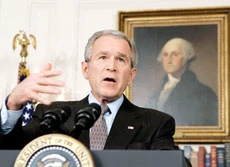
WASHINGTON, 22 March 2007 - As crises continue to swarm around his presidency, President George W. Bush is finding fewer allies in his corner: His most recent headaches include Republicans nervousness about the increasingly unpopular Iraq war, Attorney General Alberto Gonzales' alleged abuse of power over the firing of eight US prosecutors, FBI abuses of the Patriot Act and the scandalous treatment of war wounded at the Walter Reed Army Medical Center.
As Bush and congressional Democrats clashed on Tuesday over Gonzales, Republicans still standing with the president on Iraq are having a hard time supporting him on domestic measures, reluctant to take stands that could be used against them politically.
"I think Republicans are in a very awkward position of having to defend a number of indefensible acts," said GOP strategist Scott Reed. "It's causing them to move into the every-man-for-himself mode."
But yesterday the focus was on Gonzales and Bush. The president made his first extensive comments about the prosecutor scandal Tuesday, defending his embattled attorney general, denying that political pressure had led to any of the firings and insisting "there is no indication that anyone did anything wrong."
He accused the Democrats of trying to score political points by threatening to subpoena White House officials. "We will not go along with a partisan fishing expedition aimed at honorable public servants," he said.
"It will be regrettable if they choose to head down the partisan road of issuing subpoenas and demanding show trials when I have agreed to make key White House officials and documents available."
Bush said he was worried that allowing testimony under oath would set a precedent on the separation of powers that would harm the presidency as an institution.
White House Counsel Fred Fielding offered to have Bush officials speak in private, not under oath, without a transcript, to members of the relevant committees. Leaders of the House and Senate judiciary committees rejected the offer and said they would start authorizing subpoenas within 24 hours.
Senate Judiciary Committee Chairman Patrick Leahy, D-Vermont, said his committee will vote today on whether to subpoena Bush adviser Karl Rove, former White House Counsel Harriet Miers and other officials. "Testimony should be on the record and under oath. That's the formula for true accountability," said Leahy said.
The controversy over the December 2006 firings of eight US attorneys focuses on the fact that all the prosecutors were appointed by President Bush and announced they were resigning from office in late December or early this year.
Also Tuesday, the Senate approved 94-2 a measure that would force the administration to gain Senate confirmation for anyone named to replace a US attorney. The measure would strike out a provision of the Patriot Act that allowed the administration to fill a vacancy for any the 93 US attorneys without Senate confirmation.
Democrats also accused the Bush administration of failing in its latest release of documents to provide a full accounting of why they dismissed eight US attorneys. They said that more than 3,000 pages of documents, including many e-mails from top deputies to Attorney General Alberto Gonzales, were incomplete and heavily redacted.
The documents paint a portrait of a Justice Department using its authority over the 93 US attorneys and then worried about containing the political damage from the firings as they became public in January.
The documents showed top Justice Department officials even offered suggestions to the fired prosecutors on how they should craft their resignation letters, recommending they say "I deeply appreciate the opportunity to have served" and "I wish you and your administration the best of luck and success."
California Democrat Dianne Feinstein was the first lawmaker to charge the prosecutors had been fired by the administration rather than stepping down on their own. She charged that the White House wanted to use a little-known provision of the Patriot Act to fill the created vacancies without going to the Senate for confirmation as had been required for US attorneys.
House and Senate Democrats said the documents released thus far showed the White House remains more focused on damage control than providing Congress answers about whether the dismissals were politically motivated.
The two sides appeared on a collision course, and if neither side blinks, the dispute could end in court -- ultimately the Supreme Court -- in a politically messy development that would prolong what Bush called the "public spectacle" of the Justice Department's firings, and public attacks on the eight US attorneys.
Asked if he would fight Democrats in court to protect his aides against congressional subpoenas, Bush declared: "Absolutely," in televised remarks from the White House.