
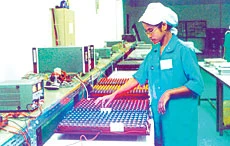
The concept of Export Processing Zones (EPZs) is not entirely new. It is a kind of ‘Free Trade Zone’ that combines manufacturing and trading activities. According to the United Nations Industrial Development Organization, an Export Processing Zone ‘involves the establishment of modern manufacturing plants-inside a customs-bonded industrial estate by offering suitable package of investment incentives to both foreign and domestic entrepreneurs’. The concept is to provide incentives for investment, especially to motivate multinational corporations or conglomerate companies to use the Zone as a low-cost production base for labor-intensive component manufacturing, assembling and middle-stage processing for exporting to home or external markets (Monsur, 1999).
Export Processing Zones have different names in different countries. Of these, the well-known examples are Free Port (FP) in some Latin American countries; Free Trade Zone (FTZ) in the USA; Free Zone (FZ) in Switzerland, Spain, Yugoslavia, Argentina, Chile, Syria, Paraguay and Singapore; Trade Development Zone (TDZ) in the United Kingdom; Industrial Zone (IZ) in the United States, Italy and Britain; Industrial Estate (IE) in Britain, USA, France, Singapore, Malaysia and India; Industrial District (ID) or Industrial Park (IP) in the UK, USA, Puerto Rico and Canada; Free Industrial Zone (FIZ) in Colombia. Other names include Transit Zone, Free Zone and Free Transit Zone. However, the name Export Processing Zone (EPZ) is most popular and widely used particularly in Asia (Monsur, 1999).
EPZs can be of three types: (a) manufacturing; (b) warehousing; (c) combination of both. EPZs of Bangladesh are of manufacturing type. Currently around 900 Export Processing Zones throughout the world enable manufacturers, assemblers, importers or exporters to benefit from a variety of privileged facilities.
Bangladesh Export Processing Zones Authority (BEPZA) was set up by an Act of Parliament in 1980 to attract foreign capital and technical know-how and thereby boost exports through establishment of export-oriented industries in special zones with special facilities. Earlier in 1980, the Foreign Private Investment (Promotion and Protection) Act was passed by Parliament for promotion and protection of foreign investments.
As per these Acts, BEPZA, an autonomous statutory body, came into being in 1983. It was entrusted with the responsibilities of setting up and operating EPZs in the country. The objective of setting up EPZs was to provide investors with a congenial investment climate free from excessive procedural complications. Accordingly, the Chittagong EPZ, the first EPZ in Bangladesh, was established at Patenga in the port city of Chittagong; it became fully operational in 1984. It was followed by the launching of the Dhaka EPZ in 1993. Since then, four more EPZs have been set up at Mongla, Comilla, Ishwardi and Nilphamari.
The principles and procedures governing setting up of industries in EPZs was approved by the Executive Committee of National Economic Council (ECNEC) in its meeting held on 19 March 1981. It prescribed the setting up of three types of industries in the EPZs. These are: (a) 100 percent foreign owned, including investment by Bangladeshi nationals ordinarily resident abroad (Type-A); (b) Joint venture projects between foreign and Bangladeshi entrepreneurs resident in Bangladesh (Type-B); (c) 100 percent ownership by Bangladeshi entrepreneurs resident in Bangladesh (Type C).
Foreign investors are required to invest in convertible foreign currencies. There are options to establish public/private limited companies or sole proprietorship/partnership concerns.
All foreign investments in Bangladesh are secured by the Foreign Private Investment (Promotion and Protection) Act, 1980. The insurance and finance programs of Overseas Private Investment Corporation (OPIC), USA, are applicable here. Security and safeguards are available under Multilateral Investment Guarantee Agency (MIGA), of which Bangladesh is a member. An arbitration facility of the International Centre for the Settlement of Investment Disputes (ICSID) is also available.
The BEPZA, which has been placed directly under the Prime Minister’s Office, offers one window, same-day services with simplified procedures to the prospective investors. These include issuance of required import/export permits and provision of required infrastructure/support service facilities in the EPZs. Potential investors are required to deal with only BEPZA for investment and all other operational purposes.
The fiscal incentives offered by the EPZs of Bangladesh include: duty-free import and export; relief from double taxation; exempt from dividend tax; GSP facility; duty-free import of 3 vehicles; expatriates exempted from paying income tax for 3 years; accelerated depreciation on machinery or plant; remittance of royalty, technical and consultancy fees. The non-fiscal incentives include: 100 percent foreign ownership allowed; no ceiling on foreign investment; full repatriation of capital and dividend.
With its privileged location beside the Bay of Bengal, Bangladesh is now attracting the attention of global investors as a hub of export-oriented international manufactures. The international entrepreneurs are attaching top priority to Bangladesh because of the country’s close proximity to the fast growing South and South Asian markets and the fact that she is within easy reach of the Middle East.
Another reason for Bangladesh’s attraction to foreign investors has been the availability of most inexpensive and productive labor force. This has made the EPZs of Bangladesh the optimum profit earning bases in the world. Prospects are further boosted by the fact that the present government of Bangladesh is pursuing a most liberal policy with regard to foreign investment. The role of the government is now promotional rather than regulatory.
Changing economic and political conditions in the Asian region are now prompting many international investors to reassess their investment strategies and plan for relocating their investments. Those changes are providing opportunities for Bangladesh to attract higher levels of FDI and take up production and marketing operations that are being shifted from other countries. Rising wage rate and production cost in many Asian countries, such as the Philippines and Vietnam are making them less attractive as sites for labor intensive low-cost manufacturing. The labor cost in Indonesia, Malaysia and Thailand is also on the higher side of the spectrum. In this backdrop, the EPZs of Bangladesh have the potential to become lucrative sites transfer of investment resources. It may be pointed out that investors from Japan, South Korea, USA, UK, China, Hong Kong, Singapore, Malaysia, Taiwan, Thailand, Spain, Panama, Germany, France, Belgium, Netherlands, UAE, Canada, Italy, India, Pakistan and Bangladesh have already invested in the EPZs of Bangladesh.
Bangladeshi EPZs are excellent places for setting up labor-intensive high-tech industries and relocation of sun-set industries from abroad. As a consequence of low wage-bills and import cost, the cost of production can be kept very low. Bangladesh’s geographic location is also an advantage for foreign investment. Through reforms and liberalization, the present government in Bangladesh has been tackling the macro-economic and structural problems of the country quite well. Various measures have also been initiated to attract foreign investment, which include provision for setting up private export processing zones in Bangladesh. A number of countries have already shown interest to set up private EPZs in Bangladesh. One South Korean investor is already setting up a private EPZ on the bank of the river Karnaphuli in Chittagong. This EPZ will cover an area of 2600 acres and is likely to be operational within the next two years. The government is sanctioning additional private EPZs and industrial estates for large-scale industrialization in the country.