
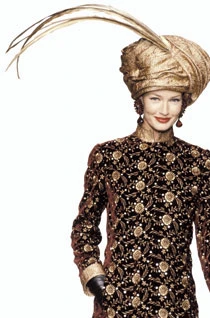
"A designer cannot ignore international events.” This is what Karl Lagerfeld of Chanel said when he was asked why dark colors were dominant in his collection. Designers get ideas for their collections from the environment around them, from nature, society, and political events. Thus we see many collections in which well-known designers employ, implement, and even combine different cultures to make of them something unique, special, and appealing. When observing the work of different designers, one can see how fashion can take us on a world tour. This year, for example, turbans from Africa, India and the Middle East feature in many collections.
Turbans are seen in almost every fashion house. What is different, however, is that they are not for men but are designed especially for women. Perhaps designers are looking for new creative ways to cover hair — ways far distant from the usual scarves that often have racial or religious connotations Turbans are being introduced to young women and designers have created new ways to match traditional them with the present casual style.
Antonio Marras in his collection for Kenzo introduced the African turban with its bright colors and its special big tie in front. Prada, on the other hand, introduced turbans made of satin; they were a combination of African designs and those that were common in Europe in the 18th and 19th centuries. Though the fashion disappeared in the West, it still exists in some Caribbean islands and has now reentered European fashion houses. Ralph Lauren is also attracted to turbans but he prefers Indian ones. His turbans cover all the hair and have a brooch in the middle which can be replaced by any piece of jewelry the wearer likes.
The idea of the turban goes back thousands of years. People in the Middle East, Africa and India have been wearing turbans for centuries. Usually worn by men, the turban protected the head from the burning heat of the tropical sun. It is said that the word derives ultimately from the Persian “dulband” which went into Turkish as “tulbent.” The turban is known as Imma or Amama in the Arab World, distar in Iran, and a safa in India.
The ways in which men tie their turbans differ from place to place and sometimes the differences are simply because of weather. The Arabs have even written whole books on the art of wearing turbans and have even glorified them and turned them into symbols. In some conservative communities, such as in Iraq, taking off the turban could cost the person his life if he removed it intentionally! In India young Sikhs are obliged to put on a turban to indicate that he has become a mature man. They also wear turbans to hide their hair which they never cut. Over time Islamic and Arabic turbans came to be associated with preachers and religious figures. Even the color of the turban indicates the role or the status of the person wearing it. White is for imams while black or sometimes green indicate men who are descendants of the Prophet (pbuh). Turbans of course vary in color as well as in size. Some wearers add a great deal to their natural height by wearing tall turbans.