NEW DELHI, 4 April 2007 — Leaders from South Asian nations yesterday called in unison to root out terrorism and combat poverty in the region.
They called for vigorous efforts to thwart the menace of terrorism, slow climate change, and tackle energy and food shortages as they met for an annual regional summit.
Economic progress in the troubled region, home to nearly 1.5 billion people or one-fifth of humanity, is impossible without overcoming security issues, leaders of the South Asian Association for Regional Cooperation (SAARC) said.
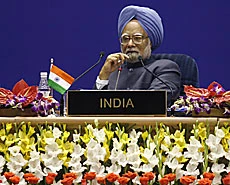
“We should implement in a meaningful and sincere manner the commitment and pledge made to root out terrorism to create an atmosphere for our endeavor to succeed,” Indian Prime Minister Manmohan Singh told the opening day of the two-day meeting in the Indian capital.
Following a round of meetings between the South Asian leaders, an Indian Foreign Ministry official said late Tuesday that fighting terrorism will be a key plank in the final declaration of the summit when it ends today.
“Seven out of eight SAARC countries have identified terrorism as a major problem,” the official said.
SAARC is made up of Bangladesh, Bhutan, India, the Maldives, Nepal, Pakistan and Sri Lanka — accounting for half the world’s poor - and the seven countries signed a declaration yesterday admitting Afghanistan as a member.
The group, set up to speed economic development and trade, has made little progress since its formation in 1985, largely because it has been held hostage by tensions between India and Pakistan, which have fought three wars, two over the disputed Muslim-majority region of Kashmir.
Pakistan Prime Minister Shaukat Aziz called for a fresh start, urging nations to make SAARC “goal-oriented” and adding there was a need to resolve disputes between countries through “dialogue and compromise.”
“Our progress remains short of our aspirations,” said Aziz, blaming violence and conflict management that had “drained our energies.”
A South Asian Free Trade Agreement (SAFTA), which came into force last year and was billed as crucial to boosting living standards, is yet to be fully implemented while Pakistan holds out to settle its political differences with India. In a move to boost regional trade, India said it was ready to accept its “asymmetrical responsibilities” and give unilateral zero-duty access to least developed member nations such as Nepal and Bangladesh.
Officials say SAARC member states badly needed to overcome mutual suspicions and work harder if they wanted to inject new momentum into the bloc, viewed as a forum for talk and not action.
The region is wracked by political turmoil with violence in Pakistan and Afghanistan, an insurgency in Indian Kashmir and an upsurge in fighting between Sri Lankan troops and Tamil Tiger rebels. Bangladesh is being ruled by a military-backed interim government installed after months of street protests over allegations of vote-rigging.
Sri Lankan President Mahinda Rajapakse, seeking support to deal with Tamil Tiger rebels on the island, warned that unless countries acted collectively, “trans-border groups will find safe havens in other parts of the region.”
“Modern day terrorists operate in a multi-dimensional fashion. They operate politically, militarily, financially and ideologically,” Rajapakse said.
Afghan President Hamid Karzai, speaking for SAARC’s newest member, highlighted the bilateral tensions with a veiled swipe at Pakistan.
He mentioned “political sponsorship” of terrorism that he said needed to be eliminated.
Afghanistan, seen by the group as a gateway to Central Asian markets, accuses Pakistan of continuing to support Taleban rebels.
India’s prime minister, however, said the time had come for SAARC members to bury their differences to realize the vision of prosperity, cooperation, peace and development.
“We should break with the past and join hands to overcome the challenges,” Manmohan said. Major powers such as China, the European Union, Japan, South Korea and the United States were attending as observers.
Iran has also been given preliminary approval to join with observer status, despite rising tensions between Tehran and the west over its capture of 15 British naval personnel and widespread concerns over Iran’s refusal to limit its suspected nuclear program.