
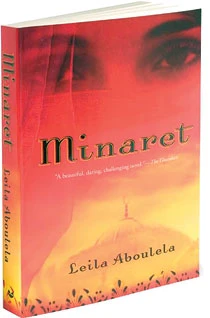
OVER the past ten years a series of novels written by Muslim writers have appeared in bookshops. They represent the voice of Muslims with their customs and beliefs who are living in the West. One such writer is Leila Aboulela, a Sudanese woman whose second novel, “Minaret,” is now available in paperback. Her first novel “The Translator” was published in 1999 and was followed by a collection of short stories “Colored Lights” in 2001. The collection includes the winner of the Caine Prize for African Writing, “The Museum.”
Leila Aboulela was born in Khartoum in 1964. In 1988, with her husband and two sons, she left for the United Kingdom. She acknowledges that in 1989 in London, colored people were categorized as either “Black” or “Asian.” This anonymity, however, is precisely what helped her wear the hijab although her friends did not approve of it. It created a social void in which she felt free to wear the hijab. Leila Aboulela also believes that nowadays the media’s portrayal of Islam is getting more sophisticated and more diverse.
Her Islamic faith and Arab Islamic feminism were nurtured by both her Egyptian mother and grandmother. Her grandmother studied medicine in the 1940’s which was rare at the time and her mother became a university professor. Aboulela’s female characters find a moral comfort in their Muslim faith. The author herself feels that “a religious identity brings more stability than a national identity and that one can also carry religion everywhere whereas other things can easily be taken away.”
Her novels aim to make Islam more familiar to the reader, a goal she has certainly achieved with her “Minaret.” Dubbed halal fiction, “Minaret” tells the story of a woman rediscovering Islam. One of the greatest qualities of the novel lies in its graceful prose. Thanks to the lively dialogues, interesting characters and gripping story, the pages seem more like pictures in a movie. I overcame the disappointment of finishing the book so quickly by reading it a second time.
Najwa, the heroine, reminds us how fragile our lives are: “No matter how much you love someone, they will die. No matter how much health you have or money, there is no guarantee that one day you will not lose it. We all have an end we can’t escape.”
Brought up in a wealthy family in Khartoum, Najwa’s Westernized life comes to an abrupt end when her father, a close friend of the president, is arrested, tried and sentenced to death. Her exile in London hastens her fall from grace: “When Baba was hanged, the earth we were standing on split open and we tumbled down and that tumbling had no end, it seemed to have no end, as if we would fall and fall for eternity without ever landing. As if this was our punishment, a bottomless pit, the roar of each other’s screams. We became unfamiliar to each other simply because we had not seen each other fall before.”
Although the author talks little about the political situation in Sudan, we are shown how the Sudanese westernized elite in the 1980’s gave way to a fundamentalist movement. In one of the most moving passages in the novel, Najwa finally decides to put on the hijab and what she feels when she goes out for the first time covered with a scarf. “When I went home, I walked smiling, self-conscious of the new material around my face. I passed the window of a shop, winced at my reflection, but then thought ‘not bad, not so bad’. Around me was a new gentleness. The builders who had leered down at me from scaffoldings couldn’t see me any more. I was invisible and they were quiet. All the frissons, all the sparks died away. Everything went soft and I thought, ‘Oh, so this is what it was all about; how I looked, nothing else, nothing non visual.’ The more I learnt, the more I regretted and at the same time, the more hope I had. Sometimes the tears ran down my face. I sweated and felt a burning along my skin, in my chest. This was the scrub I needed. Exfoliation, clarifying, deep-pore cleans words I knew from the beauty pages of magazines and the counters of Selfridges. Now they were for my soul not my skin.”
Like her heroine, Najwa, the author has been uprooted. Leila Aboulela lives now between Dubai and Aberdeen. And both women also struggle with the past. If we are left with the image of Najwa dreaming of her family in Khartoum during the good days, the author believes that one must not be nostalgic for the past: “I fight against that, it’s pointless.”