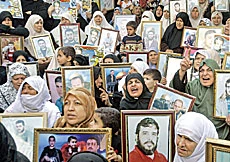
RAMALLAH, 10 April 2007 — Despite their bleeding wounds sustained during the internal fighting, Palestinians commemorated the 59th anniversary of the massacre in the Deir Yassin village, where more than 250 Palestinian citizens, including children, women, and elderly people were slaughtered at the hands of armed Zionist gangs in 1948.
According to historically documented facts, Palestinian citizens in the village, which is located just four kilometers to the west of Jerusalem, were stunned by armed members of the Zionist gang called Irgun that was led by Menachem Begin. They stormed their village and massacred innocent civilians in the early hours of April 9, 1948. Begin became the prime minister of Israel in 1977.
Another Zionist group, the Stern group, which is led by Yitzhak Shamir, who succeeded Begin in the premiership post, had also participated in the massacre. “Results of this carnage were very great and beyond our expectations as it forced hundreds of thousands of Arabs to flee their homeland fearing for their lives,” Begin said about the massacre.
“We have spread paranoia among the Arabs, and by a single attack we succeeded to change our strategic condition,” he was further quoted as saying of the carnage his group committed. In the wake of the blood bath in Deir Yassin, armed Zionist gangs united and formed the nucleus of the Israeli occupation forces that later drove 750,000 Palestinian citizens out of their homeland at gunpoint, and established the Hebrew state on those lands.
Meanwhile, a Palestinian guard of Al-Aqsa Mosque in Jerusalem was injured yesterday after being attacked by dozens of Israeli policemen escorting right-wing Israeli fanatics who infiltrated Al-Aqsa Mosque compound. Palestinian sources in Jerusalem said that an argument broke out between the guard, Mahmoud Al-Khatib, and the Israeli police. The sources said that more than 30 Israeli policemen hit the Palestinian guard and tore his clothes before taking him to the adjacent police station in Al-Maskoubiya prison, where he was accused of attacking the police forces and obstructing them.
In another development, for relatives of Hamas fighter Mohammad Al-Sharatha and others jailed by Israel, progress toward a deal to swap Palestinian prisoners for an Israeli soldier was a rare sign of hope. “We have been awaiting this day,” Sharatha’s wife, Umm Nimer, said yesterday as she and her family appealed to Palestinian leaders to include husbands, fathers and sons among those released in exchange for Israeli Cpl. Gilad Shalit.
Freeing leading fighters from Israeli jails is a highly emotive issue for Palestinians, as well as for Israelis who have lost relatives in attacks. “He killed my son,” said Gilbert Saadon, mother of one of the Israeli soldiers killed in a 1989 Hamas attack linked to Sharatha. Local press reports said Sharatha was on the list but that has not been confirmed by Hamas.
Other Israelis who have lost family members in Palestinian attacks said they would support a swap in order to ensure Shalit returns to his home after 10 months of captivity in Gaza
Hamas, which now leads the Palestinian government, has handed over the names of Palestinian prisoners it wants the Jewish state free in exchange for Shalit. Hamas is reportedly demanding the release of 1,300 prisoners, including Marwan Barghouthi, a Fatah leader widely seen as a possible successor to the moderate Abbas.