
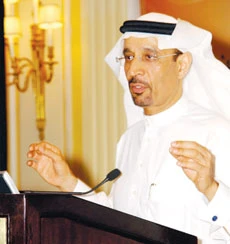
ALKHOBAR, 12 April 2007 — A Saudi Aramco executive has asked engineers to lend their support to the nation’s economic development drive as well as to help improve the Kingdom’s education during a speech delivered to the Saudi Chapter of the American Institute of Chemical Engineers.
Khalid A. Al-Falih, senior vice president for Industrial Relations, made the remarks on Sunday during a speech held at a hotel in Alkhobar. He said Saudi Aramco is making a huge push to increase feedstock for the Kingdom’s growing petrochemical industry because of the importance of diversifying the economy as well as adding value domestically to the nation’s petroleum wealth by tapping into the potential of the $2.3 trillion global chemical industry.
Saudi Aramco is engaged in several mega-projects to boost feedstock and add oil and gas increments to the Kingdom’s energy stream. The Kingdom is also undertaking an ambitious expansion in the chemicals business with the intent of diversifying its portfolio and adding more value. Al-Falih said a shortage of engineers is making those jobs more challenging.
“We are building the capacity and the capability,” Al-Falih said. “What is restraining us is a global shortage of talent.”
He noted that in just five years, the demand for engineers by Saudi Aramco and Saudi Arabian Basic Industries Co. is more than quadrupling. Al-Falih, who holds a mechanical engineering degree from Texas A&M University, said engineers hold 62 percent of Saudi Aramco’s management positions, although they constitute a relatively smaller percentage of the company’s work force. He commended the Ministry of Education for raising the Kingdom’s literacy rate to just under 90 percent in a few decades but said now was the time to further develop the educational system to be “internationally competitive” with a focus on science and mathematics.
He added that under Saudi Aramco’s training and education programs — usually consisting of the Kingdom’s better students — about 74 percent needed remedial help to achieve program requirements.
“When we look at tables looking at the number of engineers per 100,000 residents, Britain leads the pack with an average of 5,300,” he said. “In Saudi Arabia that number is 460.” “Of course, those of us with young children should take an active role in education and get involved in the schools and work with teachers to improve results,” he added.
“We also need to make sure that high school students know that engineering is one of the best fields to get into,” he pointed out. “Members of professional societies, such as this one, can participate individually by mentoring and teaching or helping out by lecturing in an educational institution. I think such participation by professionals such as you, bring a lot to a campus. Professional groups can contribute a lot. Not only does it advance your profession, but it can also help the nation achieve its goals.”