RIYADH, 29 April 2007 — Japan’s Prime Minister Shinzo Abe proposed yesterday to forge a “multilayered relationship” beyond oil with the Middle East, hoping to herald a new era of ties between Tokyo and the region.
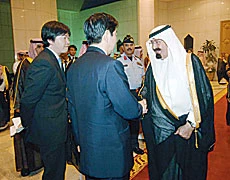
Abe arrived in Riyadh earlier at the start of a Middle East tour aimed at bolstering Japan’s presence in the region. He later met with Custodian of the Two Holy Mosques King Abdullah and discussed major regional and international issues and ways of strengthening bilateral relations.
Speaking at a forum of about 300 Japanese and Saudi businessmen in Riyadh, Abe said Japan would contribute to the development of human resource in the Kingdom. “One of the aims of my visit is to establish multilayer economic relations that go beyond traditional economic relations that focus on oil,” Abe said.
The prime minister said that he wanted to establish “a new era of relations between Japan and the Middle East” in which strategic relations between Japan and the Kingdom would include cooperation in combating terrorism, discussions on developments in the region, and cooperation on the humanitarian front. He also called for more understanding between the Islamic world and Japan.
Abe said the fact that a large delegation of Japanese businessmen from the nonpetrochemical and gas sectors had accompanied him signaled his country’s willingness to develop relations with the Kingdom on all fronts.
Senior officials from giant electronic companies such as Sony, Toshiba, Canon and Fujitsu, and representatives from the banking sector, the heavy industry sector, the automobile industry, the tire industry and the airline industry also attended the forum.
Abe joined Crown Prince Sultan for lunch. According to a Japanese government statement, Prince Sultan said: “I agree with the view of Prime Minister Abe that relations between Japan and Saudi Arabia should be multilayered.”
The Japanese premier also proposed to import more oil from the Kingdom as part of an ambitious plan to stockpile them in its Okinawa oil reserve facility to ensure stable supplies.
“Prime Minister Abe has made the proposal to store oil in Okinawa oil base in Japan’s southernmost prefecture,” said Noriyuki Shikata, a spokesman for Abe.
Referring to Abe’s talks with Crown Prince Sultan, Shikata said that “the idea of storing oil supplies will be followed up on the working level.” He said that “this was an important project from the Japanese point of view because Tokyo imports 35 percent of its oil from Saudi Arabia.” Japan has virtually no oil or gas reserves of its own and relies for more than 70 percent of its oil supply on four Gulf States including Saudi Arabia. The Kingdom has been exporting $37 billion worth of oil and petroleum-related products annually. Although Japan has not so far been successful in reducing its dependency on oil imports, it has gone a long way in reducing its vulnerability.
“But, it does not mean that the visit of Japanese premier is limited to oil diplomacy,” said Hiroshige Seko, special adviser to the prime minister. In its effort, Japan has tried increasingly to show that it has interests in the Middle East beyond oil. Seko said that “Abe seeks to broaden cooperation with the Kingdom, and is ready to exert all efforts for a peaceful settlement of Middle East issues — Iran, Iraq and Lebanon.” Although Tokyo is not one of the Quartet — the US, Russia, the EU and the UN — Japan it is keen on playing a role in helping build mutual trust.
On his part, Minister of Trade and Commerce Hashim Yamani said the Saudi Arabia-Japan Business Forum was a rich opportunity to strengthen economic relations between the two countries. He noted that Japan was the No. 1 importer from the Kingdom in 2005 and ranked the second largest exporting country to Saudi Arabia.
Yamani said the Kingdom has always been a major player in shaping the global economy, noting that the Kingdom was ranked No. 12 in the world in terms of exports and No. 22 in terms of importing goods in the global market. “This has been established with the support of a lenient commercial system in addition to a 20 percent reduction in taxes on profits of foreign companies,” he said.
Yamani added that the fact that the Kingdom had joined the WTO had strengthened the country’s ability to attract foreign investment. “I urge Japanese businessmen and investors to invest in the Kingdom and benefit from the privileges of a lenient foreign investment system,” he said, adding that the Kingdom also had the necessary infrastructure, services, and location.
President of the Council of Saudi Chambers of Commerce and Industry Abdul Rahman Al-Rashed said: “We have the urge to attract more Japanese investments in the Kingdom, especially in light of the Kingdom launching mega economic and infrastructure projects.”