
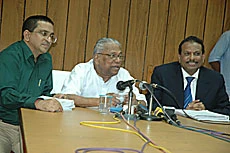
KOCHI, 28 July 2007 — Air Kerala International Services Limited (AKISL), one of the subsidiaries of the Cochin International Airport Limited (CIAL), has decided to explore the possibility of a tie-up with a domestic airline having five years of flying experience, to launch low-cost flights on the Kerala-Gulf sector.
“The AKISL’s board of directors has authorized me and M.A. Yousuf Ali (an NRI director of the company) to explore possibility of starting the project as a joint venture,” the CIAL group’s Managing Director S. Bharat said.
“We’ll hold discussions with the domestic companies who have five years of domestic flying experience to try and kick-start the project with a view to setting up a low-cost airline company to start both domestic and international operations,” he said.
During these discussions, the company would also explore the possibility of starting cargo services to national and international destinations from the Cochin airport. As the first airport-based airline of the country, it hopes to cut on operating costs considerably.
Chief Minister V.S. Achuthanandan is the chairman of the CIAL and its subsidiaries. Besides Yousuf Ali, one of the directors of Abu Dhabi Chamber of Commerce and promoter of retail chain Lulu Hypermarkets, Transport Minister Mathew T. Thomas is also on the AKISL board.
The meeting of the AKISL board followed the CIAL meeting that was held in the chief minister’s office here last week.
Bharat said another CIAL subsidiary, Cochin International Aviation Services Ltd (CIASL), which is implementing the maintenance, repair and overhaul (MRO) and aviation projects, has appointed Aerobiz International as its consultant. The civil works for the hangars and the aviation academy have started.
“Global bids have been invited to explore the possibility of forming joint ventures with major national and international MRO and airline companies and international aviation academies.
A large number of national and international players have responded to these bids and CIASL is in the process of technical evaluation of these bids to work out a joint venture model,” he said.
According to reports, India’s aviation authorities want to extend to 2010 the ban on private sector Indian carriers flying to the Gulf region to ensure financial stability of the state-run Air-India, Indian and Air-India Express.
On Dec. 30, 2004, India announced its new open skies policy and allowed two private sector airlines, Jet Airways and JetLite (formerly Air Sahara), to fly out to all international destinations except in the Gulf.
It was also decided that the moratorium on private airlines flying to the Gulf region would be in place till January 2008, which is now to be extended for another two years if the reports are to be believed.
Only the Air-India Express, the low-cost subsidiary of the Air-India, was granted permission to operate in the Gulf.
The Gulf routes are considered important for the state-owned airlines as bulk of operational revenue and profits accrue from these routes. India’s lower house of Parliament also witnessed heated exchanges between Aviation Minister Praful Patel and Kerala lawmakers who call the state-owned carriers “looters.”
The state government has planned the low-cost airline to help the poor workers in the Gulf who cannot afford exorbitant airfare to spend their yearly vacations. Twenty percent of the seats on the new airline are to be reserved, at a subsidized fare, for those who have been held up in the Gulf for long for want of money.
The aviation authorities have also inked several bilateral air services agreements with countries in the Gulf that has seen a huge increase in the number of seats available for passengers. It was liberally accepting request of all the eligible airlines for additional entitlement while conducting bilateral air service negotiations.
The ruling Left Front, which props up the minority government of Prime Minister Manmohan Singh extending support from outside, has decided to exert maximum pressure on the federal government to get the dream project through.
Special Economic Zone Status
Bharat said the board decided to apply for Special Economic Zone (SEZ) status for the airport city, spread over some 1,400 acres.
“If the federal government grants permission it would be the first airport-based SEZ in India and that would give a big boost to the projects being undertaken by CIAL as part of its land utilization plan,” he said.
The CIAL also plans several non-aviation projects like a Software Park, shopping malls, hotels and a golf course on the airport premises.
“This would entail the company to avail a large number of tax exemptions and benefits offered by the federal and state governments for the SEZ resulting in huge inflow of investments into the projects and make them cost effective. This would also provide a huge boost to the shareholding value,” he said.
The company registered a profit before tax of Rs.444 million on a total turnover of Rs1.12 billion, resulting in a profit before tax ratio of almost 40 percent on the total turnover last fiscal year. Some 30 percent of its revenue came from its duty free business.
“The financial performance of the company can be acclaimed as one of the best in the logistics industry, especially in aviation in the world. Huge profit ratio earned by CIAL for the current financial year reiterates the tremendous success story of CIAL as the first public private partnership initiative in the aviation infrastructure industry in the country,” he said.
Bharat said the products retailed at the CIAL duty free shop was among the cheapest in South Asia, South East Asia and the Middle East region. The sales revenue grew by around 48 percent to Rs.325m for the financial year that ended on March 31.
He said the dividend to the shareholders was reduced to eight percent as against the previous year’s ten percent because of the rights issue at the ratio of 1:1. The eight percent dividend will entail all shareholders, in effect, to get a ratio of 12 percent return on their equity capital investment, which is two percent more than the previous year, he said.
Many an eyebrow was raised when the non-listed company’s shares, which fetch around forty times the issue price now, were given away at the face value without any premium.