
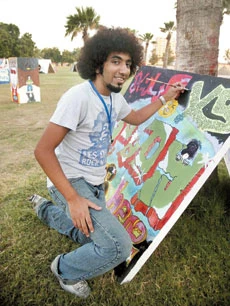
USING spray paint cans, they defaced public property, insulted the police and complained that youths didn’t have a voice in Saudi Arabia.
Dozens of young Saudis in the coastal city of Jeddah have challenged the authorities with street graffiti, which has highlighted a growing generation gap.
Signed by graffiti artists using names like G6, Boy.Z and XBoys and styled on the gaudy graffiti in big US and European cities, images began appearing two years ago on traffic circles and walls, enraging local residents who valued civic pride.
“It wasn’t a rebellion, it was self-expression,” says Abadi Zbadi, 22, a founder of graffiti gang X5. “If you go to any mall they tell you ‘it’s just for families’... You get depressed, so you might as well get into graffiti.” Wearing a T-shirt and jeans and sporting a distinctive fuzzy hairstyle, Zbadi now shows his latest work on a grassy embankment here.
After months of chasing the culprits, authorities earmarked this public park space and some big walls for street artists to paint and draw what they liked — as long as they stopped daubing graffiti elsewhere in the city.
The images focus on youthful dissatisfaction with the world.
One shows a car with legs for wheels, in a dig at the state of some of the city’s roads. Many show burning buildings or glum youngsters alongside phrases such as “For Families Only” or “Don’t play with me, I’m a criminal.”
Complaints
“First we wanted to understand why they did it,” said Mohammed Abo Umara, social development and media officer at Jeddah Municipality.
“Some want to attract attention, some have unemployment problems, some have family issues... We realized that if we left them alone it would cause great damage to the city. We preferred to solve the problem.” The municipality waived financial or other punishments and made the scribblers clean up some of the obscenities, while seeking corporate sponsors for the official spaces and walls.
“I told them that whatever they write, they should be happy with their sisters or mothers seeing it. Anything obscene and your family will be brought to see it,” Abo Umara said.
About 150 graffiti artists emerged from Jeddah’s shadows. The graffiti died down after the scheme was introduced but some rogue graffiti artists remain.
Local authorities also took the unusual step of sitting down with some of the youths to hear what was bothering them about life in Saudi Arabia, or at least in Jeddah.
What they heard was a litany of complaints that cut to the heart of life in a country reluctant to let go of traditional ways.
“The girls wanted schools where they could learn how to drive, and open-air sports areas. The boys were annoyed about not being allowed into shopping malls,” Abo Umara said.
“As a government body, we either show we are serious in dealing with them or we lose them,” he said, adding the request for driving lessons — which could provoke religious conservatives — was under consideration.
Globalization
Jeddah gangs benefit from being from powerful families.
Ordinary Saudis who dare to paint graffiti can pay a heavy price. A teenager in the northern desert town of Hafr Al-Baten was sentenced in February to 60 lashes of the whip and fined 2,000 riyals ($530) for defacing walls in his school.
“They are not from the working classes,” said Abo Umara, adding most did not need to work. “They are looking for work that fits what they were brought up to expect.” More connected to the outside world than previous generations, many of the more affluent Saudi youths wear the latest fashions and model themselves on Arab and Western stars.
Badr Al-Ghamdi, 20, said his generation of Saudis felt a sense of emptiness, or “faragh” in Arabic.
“I can say in the name of all young people here that we are repressed. What you see here is us breaking the repression,” said Al-Ghamdi, an X5 member who uses the nickname BB2.
“We did graffiti, but someone else will get into fast street car racing, or someone else will get into drugs... There are people in the dark and you don’t see what happened to them.” Society needs to listen to young people, he said.
“We’re troubled by many things. For a start, the lack of interest in us. As people always say, we are the future,” Al-Ghamdi said. “I’m a polite person but if I’m being repressed, I’m going to write graffiti saying ‘X5 was here’.”