
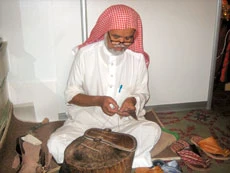
AL-KIRAZA — shoemaking — is one of the oldest crafts in Makkah. Arab News talked to, Nur Allah Khoja, an old man who has been a shoemaker for 45 of his 60-plus years. He said that he had not become a sandal maker because the craft was “in the family” but because he was attracted to it.
“I was encouraged to invent new designs and motivated to explore this world and be special in what I provide.”
He feels proud that he is able to love what he is doing and thus got the chance to start something new. “I started designing new shoes for myself and then I turned a hobby into a craft.” Khoja said that he made shoes different from those available in the market. When he began, he sold his designs to shoe shops and then decided to open his own shop and began the path which has led to his being one of the best-known kharaz in Makkah.
Khoja said that buffalo leather is used to make the base of the sandal. “We import it from India and Pakistan.” He also said that for the cover or the upper part of the sandal sheep or cow leather was used — also imported from India and Pakistan. Now, however, the skins come from the local market and according to Khoja, the leather has various names: Shargi, Hasawi, Zubairy.
It makes him three days to make one paire of sandals. “Others make three pair in a day. This shows the carefulness and precision of my work,” said Khoja.
To make a pair of sandals Khoja takes the size of the person’s feet and cuts the leather so it will cover the foot in the traditional manner. He then places the leather in water and leaves it for 8 hours. Later he dries it and puts it in oil to make it soft and easy to work with. After that he places a piece of plastic inside the leather in order to make it easy for him to sew the sandal and he starts sewing the sheep leather with the buffalo leather. According to him, the price is determined based on the number of pricks in each sandal. Some have nine; others have seven or five. The best and the most expensive and also most in demand are the ones with nine pricks. Old people tend to buy these sandals more than young. In general, people tend to buy them to be worn during the Eid festivals since they represent part of the special tradition of Makkah. Khoja, however, said that only a few people are now keen to buy these sandals and added that young people tend to go more for modern “weird” sandals.